 Bug FAQ
Grand Canyon Black Tarantula
Aphonopelma marxi · Order: Araneae · Family: Theraphosidae
Also called: Arizona Black, Arizona Dwarf, Mogollon Black

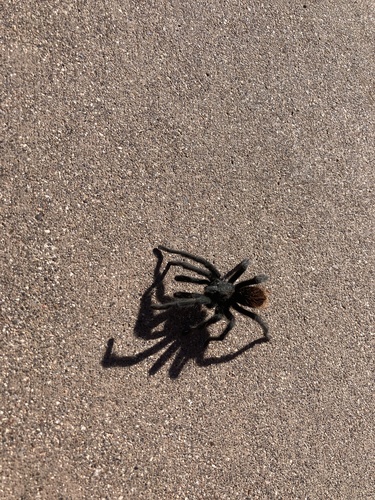
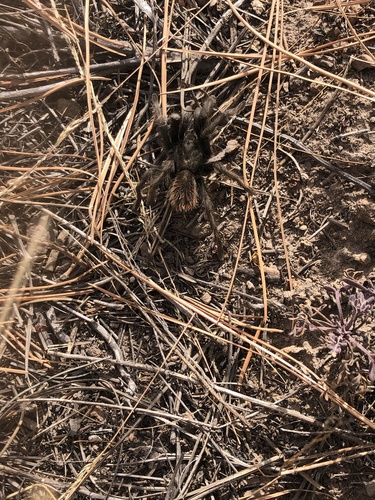
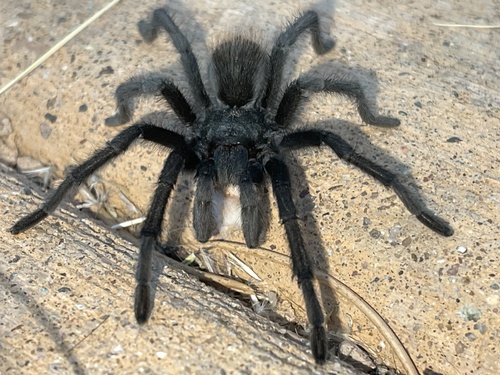
The Grand Canyon black tarantula is dark brown to black, very hairy, with orange-red hairs on its abdomen. Females reach about 35 mm in total length, while males have a carapace 8.3 to 10.5 mm long; females have a larger carapace of 13.5 to 15.3 mm. It lives in mixed conifer forests and sagebrush steppe across Arizona, New Mexico, Colorado and Utah, where it is common but stays hidden in burrows.
Source: Wikipedia
How to recognize it
The spider is generally dark brown to black, very hairy, with some orange-red hairs on the abdomen.
Source: Wikipedia
Size
Mature males have a carapace 8.3 to 10.5 mm long; mature females have a larger carapace 13.5 to 15.3 mm long. A female’s total body length, including chelicerae, is about 35 mm.
Source: Wikipedia
Where it lives
It occurs in mixed conifer forests and sagebrush steppe. The species is very common in these habitats but is hard to find because it stays in its burrow.
Source: Wikipedia
Where it comes from
It is native to the United States, specifically Arizona, New Mexico, Colorado and Utah.
Source: Wikipedia
Lookalikes
In males, the femur-to-metatarsus length ratio of the first leg exceeds 1.69, which is higher than in similar species. In females, the femur-to-metatarsus ratio of the first leg to the third leg exceeds 1.76, lower in look-alike species.
Source: Wikipedia
Where it is found in the US
Recorded in 4 of 51 states and DC. Most records: Arizona, New Mexico, Colorado, Utah.
Darker = more records. Counts are museum and citizen-science records, not population size.
Source: GBIF
Status: endemic in North America; endemic in United States. Source: iNaturalist
Months it is reported in the US
Source: GBIF
More photos

Questions people ask
How can I tell this tarantula apart from similar species?
Males have a first-leg femur/metatarsus ratio over 1.69, while females have a first-leg femur/third-leg metatarsus ratio over 1.76; both ratios are smaller in look-alike spiders.
Source: Wikipedia
Same family (Theraphosidae)


Sources
- Wikipedia: https://en.wikipedia.org/wiki/Aphonopelma_marxi
Look it up elsewhere: GBIF · iNaturalist · BugGuide · ITIS · Wikipedia
Text written 2026-10-24 from the sources above and checked sentence by sentence against them. Data fetched 2026-10-24.