 Bug FAQ
Steindachner's Ebony Tarantula
Aphonopelma steindachneri · Order: Araneae · Family: Theraphosidae
Also called: Pecos Brown

Steindachner's ebony tarantula reaches a leg span of about 12 to 13 cm (5 inches). It is dark black or deep brown in color and lives in burrows in arid ground. The spider is found in California and Baja California, Mexico, and is most active from July to October.
Source: Wikipedia
How to recognize it
Its body is a velvet black or deep brown color.
Source: Wikipedia
Size
Adults grow to a diagonal leg span of roughly 12 to 13 cm (5 in).
Source: Wikipedia
Where it lives
It inhabits burrows in dry, arid landscapes.
Source: Wikipedia
Where it comes from
It is native to California in the United States and the Baja California region of Mexico.
Source: Wikipedia
Where it is found in the US
Recorded in 4 of 51 states and DC. Most records: California, New Mexico, Arizona, Utah.
Darker = more records. Counts are museum and citizen-science records, not population size.
Source: GBIF
Status: native in North America. Source: iNaturalist
Months it is reported in the US
Source: GBIF
More photos

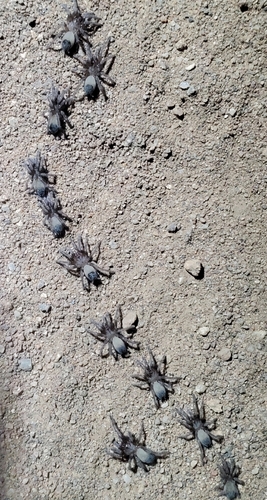
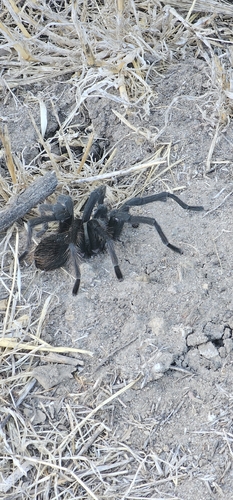
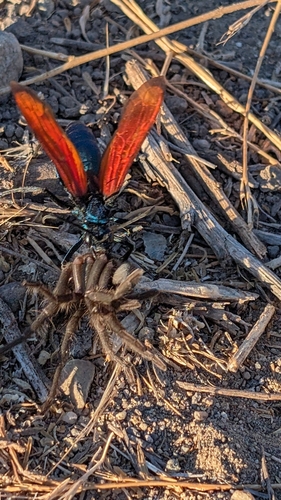
Same family (Theraphosidae)
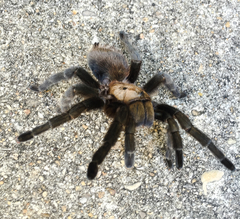


Sources
- Wikipedia: https://en.wikipedia.org/wiki/Aphonopelma_steindachneri
Look it up elsewhere: GBIF · iNaturalist · BugGuide · ITIS · Wikipedia
Text written 2026-10-24 from the sources above and checked sentence by sentence against them. Data fetched 2026-10-24.