 Bug FAQ
Gorse Pod Moth
Cydia succedana · Order: Lepidoptera · Family: Tortricidae

The adult has a wingspan of about 11 to 16 mm. Its forewings show an irregular white cross-band, some white costal spots and blurry silvery slashes near the apex. The caterpillars feed on gorse and related legumes and are released in New Zealand to control gorse seeds.
Source: Wikipedia
How to recognize it
Forewings have an irregular white cross-band (often not reaching the costal edge), white costal spots and a pair of blurry silvery slashes at the apex.
Source: Wikipedia
Size
Wingspan ranges from 11 to 16 mm.
Source: Wikipedia
How to get rid of it
The species is used in New Zealand as a biological control agent against gorse by feeding on its seeds.
Source: Wikipedia
What it eats
In New Zealand the larvae are released to eat gorse seeds as a biological control agent.
Source: Wikipedia
Life cycle
Adults are on the wing from April to September, varying with location.
Source: Wikipedia
When you see it
Flight period extends from April through September depending on where it is found.
Source: Wikipedia
Lookalikes
It cannot be reliably separated from Cydia albipicta by external appearance; genital examination is required.
Source: Wikipedia
More photos


Questions people ask
What plants do the larvae eat?
The caterpillars feed on gorse (Ulex europaeus) and related legumes such as Genista, Lotus and Cytisus scoparius.
Source: Wikipedia
When are the adult moths active?
Adults fly from April to September, depending on the local climate.
Source: Wikipedia
How can I tell this moth apart from similar species?
It looks very similar to Cydia albipicta; only a genital examination can reliably differentiate them.
Source: Wikipedia
Is this moth used for any pest-control purpose?
Yes, in New Zealand the larvae are released to eat gorse seeds as a biological control method.
Source: Wikipedia
Same family (Tortricidae)
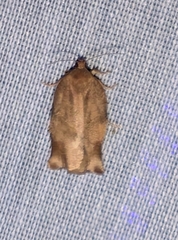 Oblique-banded Leafroller MothChoristoneura rosaceanaDamages trees, gardens or crops
 Garden TortrixClepsis peritanaDamages trees, gardens or crops
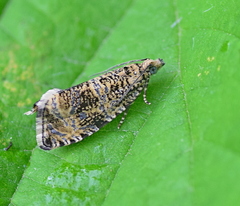 Common MarbleSyricoris lacunanaDamages trees, gardens or crops
 Red-banded Leafroller MothArgyrotaenia velutinanaDamages trees, gardens or crops
 Light Brown Apple MothEpiphyas postvittanaDamages trees, gardens or crops
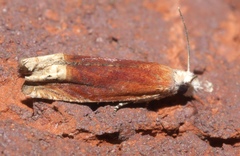 Aster and Reddish Eucosma Moths and AlliesEucosma parmatana
Sources
- Wikipedia: https://en.wikipedia.org/wiki/Cydia_succedana
Look it up elsewhere: GBIF · iNaturalist · BugGuide · Wikipedia
Text written 2026-10-23 from the sources above and checked sentence by sentence against them. Data fetched 2026-10-23.