 Bug FAQ
Golden Sweat Bee
Augochlorella aurata · Order: Hymenoptera · Family: Halictidae
Also called: Golden Green-Sweat bee
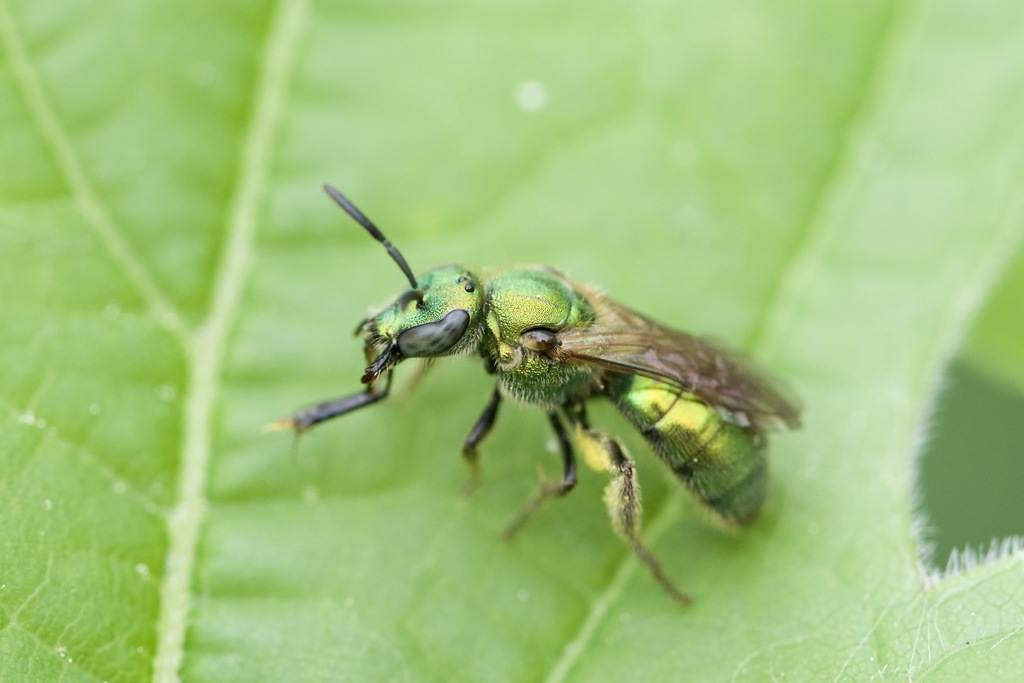
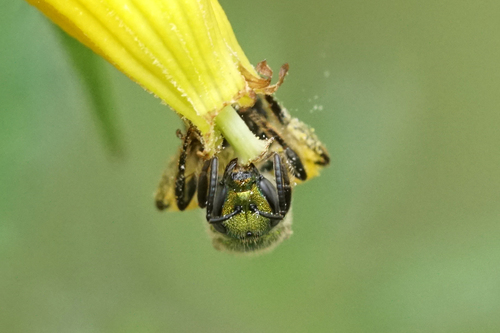
Golden sweat bees are tiny, about 5-7 mm long, with females a bit larger than males. Their bodies shine metallic green, sometimes showing copper, red, yellow, blue or pink tones. They nest in the ground, live across much of the United States, and pollinate many garden plants.
Source: Wikipedia
How to recognize it
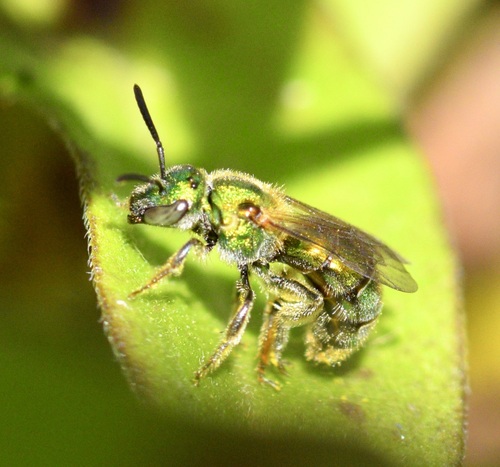
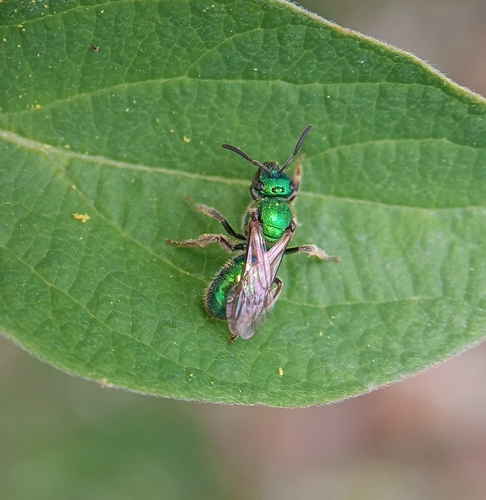
The bee’s body is a bright metallic green that can be mixed with copper, red, yellow, blue or pink shades.
Source: Wikipedia
Size
Adults measure about 5 to 7 mm, with females usually a little larger than males.
Source: Wikipedia
Where it lives
It is a primitively eusocial species that builds its nest in the soil. This species occupies the most northern part of the Augochlorini tribe, which is mainly Neotropical.
Source: Wikipedia
What it eats
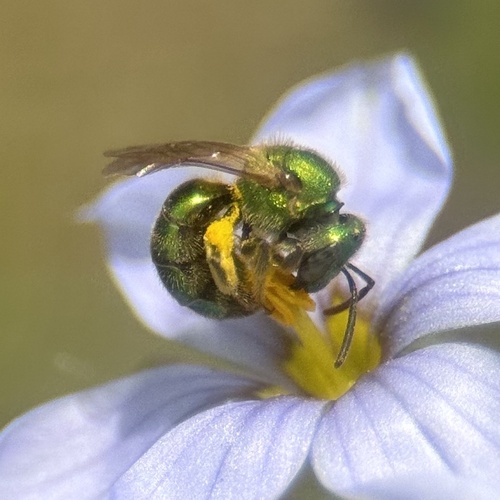
It gathers pollen from many different plants and helps pollinate horticultural crops.
Source: Wikipedia
Life cycle
In spring, an overwintered female starts a nest in the soil and raises a first brood of both sexes. Later in summer, workers help the queen produce a second brood of reproductive males and females.
Source: Wikipedia
When you see it
The colony season begins in spring with the foundress phase and first brood. The second brood mates in early fall, and fertilized females overwinter to start new colonies next spring.
Source: Wikipedia
Where it comes from
It occurs throughout the United States, especially along the east coast and spreading westward.
Source: Wikipedia
Lookalikes
Unlike Augochlora pura, golden sweat bees have unforked mandible tips. Their forewing’s marginal cell is pointed, while Augochlora pura has a squared-off cell.
Source: Wikipedia
Where it is found in the US
Recorded in 45 of 51 states and DC. Most records: Maryland, Massachusetts, New York, Virginia, Pennsylvania, South Dakota, Vermont, West Virginia.
Darker = more records. Counts are museum and citizen-science records, not population size.
Source: GBIF
Status: native in North America; native in Canada. Source: iNaturalist
Months it is reported in the US
Source: GBIF
More photos
Questions people ask
How can I tell a golden sweat bee apart from similar bees?
Look for a pointed marginal cell on the forewing and mandibles without forked tips; the body is a metallic green that may show copper or pink hues.
Source: Wikipedia
How big are golden sweat bees?
They are about 5 to 7 mm long, with females slightly larger than males.
Source: Wikipedia
Where do golden sweat bees live in the United States?
They are found across the U.S., especially along the east coast and extending westward, and are one of three species east of the Rockies.
Source: Wikipedia
Do golden sweat bees help pollinate gardens?
Yes, they collect pollen from many plants and are important pollinators for horticultural crops.
Source: Wikipedia
Same family (Halictidae)
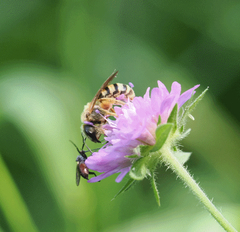
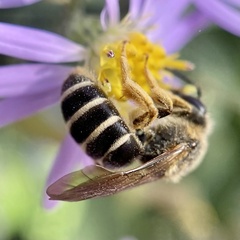

Sources
- Wikipedia: https://en.wikipedia.org/wiki/Augochlorella_aurata
Look it up elsewhere: GBIF · iNaturalist · BugGuide · ITIS · Wikipedia
Text written 2026-10-23 from the sources above and checked sentence by sentence against them. Data fetched 2026-10-23.