 Bug FAQ
Golden Jumping Spider
Paraphidippus aurantius · Order: Araneae · Family: Salticidae
Also called: emerald jumping spider, Jumping Spiders
Source: Wikipedia

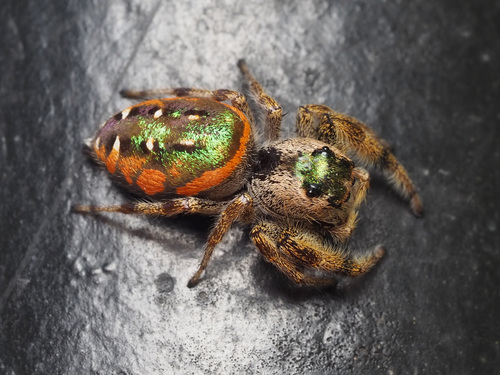
The golden jumping spider is green or black with distinctive white stripes on its head and a white border on its abdomen, plus a central line of hairs with tiny white dots. It lives on broad leaves of plants such as yucca and rosette-forming species, ranging from the United States down to Panama and the Greater Antilles.
Source: Wikipedia
Does it bite or sting?
When threatened it can bite humans. The bite is comparable to a mosquito bite and poses minimal danger.
Source: Wikipedia
Where it lives
It prefers large leaves that give shelter from rain and a good view of its surroundings. Common host plants include yucca and rosette-forming species, though this can vary by location.
Source: Wikipedia
What it eats
It actively preys on a variety of animals, including insects, other spiders, and small vertebrates.
Source: Wikipedia
Where it comes from
It is found from the United States through Panama and on the Greater Antilles.
Source: Wikipedia
Where it is found in the US
Recorded in 37 of 51 states and DC. Most records: Ohio, Virginia, Pennsylvania, Maryland, North Carolina, New York, Tennessee, Georgia.
Darker = more records. Counts are museum and citizen-science records, not population size.
Source: GBIF
Status: native in North America; native in United States. Source: iNaturalist
Months it is reported in the US
Source: GBIF
More photos



Questions people ask
Where might I find this spider?
Look on broad leaves of yucca or rosette-forming plants in the southern U.S., Central America, or the Greater Antilles.
Source: Wikipedia
How can I tell it apart from similar spiders?
Its green or black body with white head stripes, a white abdominal border, and a central hair line with tiny white dots are distinctive.
Source: Wikipedia
Same family (Salticidae)



Sources
- Wikipedia: https://en.wikipedia.org/wiki/Paraphidippus_aurantius
Look it up elsewhere: GBIF · iNaturalist · BugGuide · ITIS · Wikipedia
Text written 2026-10-22 from the sources above and checked sentence by sentence against them. Data fetched 2026-10-22.