 Bug FAQ
Goldband Thyene Jumping Spider
Thyene natalii · Order: Araneae · Family: Salticidae
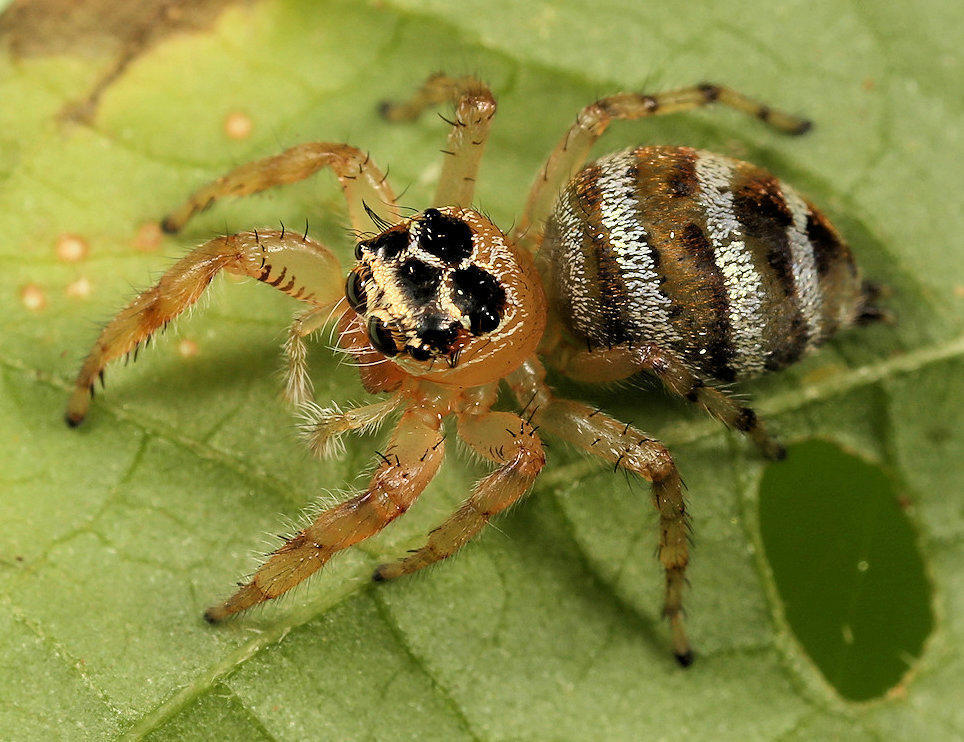
The Goldband Thyene Jumping Spider is a small spider about 5 to 8 mm long with an oval abdomen. Both males and females have distinctive crosswise bands on the abdomen, and the male’s head is dark brown with a medium-dark tan band on the sides and back. It lives throughout eastern and southern Africa, especially in South Africa’s greener biomes and some agricultural areas.
Source: Wikipedia
How to recognize it
Both sexes show crosswise bands on the abdomen, a unique trait in the genus. Males have a dark brown cephalic region with a medium-dark tan band around the sides and back.
Source: Wikipedia
Size
Adults measure between 5 and 8 mm in length and have an ovoid abdomen.
Source: Wikipedia
Where it lives
In South Africa it is found in the country's more verdant floral biomes and in several agricultural systems.
Source: Wikipedia
Where it comes from
Its distribution covers eastern and southern Africa. The species was first described from South Africa by Peckham & Peckham.
Source: Wikipedia
Lookalikes
It is the only Thyene species where both sexes have crosswise scales on the abdomen.
Source: Wikipedia
Same family (Salticidae)



Sources
- Wikipedia: https://en.wikipedia.org/wiki/Thyene_natalii
Look it up elsewhere: GBIF · iNaturalist · BugGuide · ITIS · Wikipedia
Text written 2026-10-23 from the sources above and checked sentence by sentence against them. Data fetched 2026-10-23.