 Bug FAQ
Giant Mayfly
Hexagenia limbata · Order: Ephemeroptera · Family: Ephemeridae
Also called: Big Michigan Mayfly, Golden Mayfly

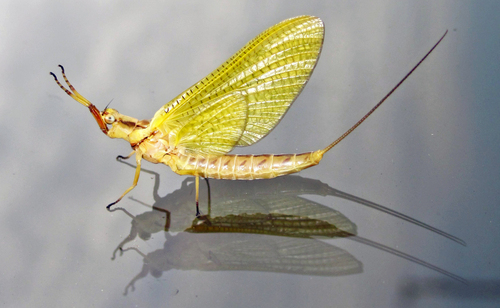
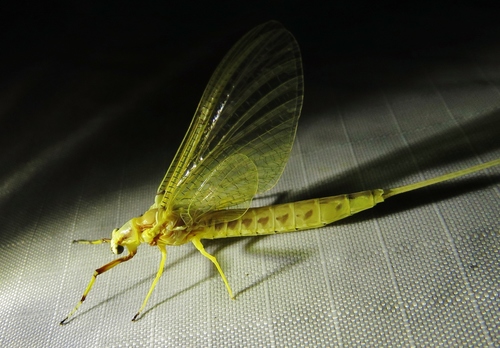
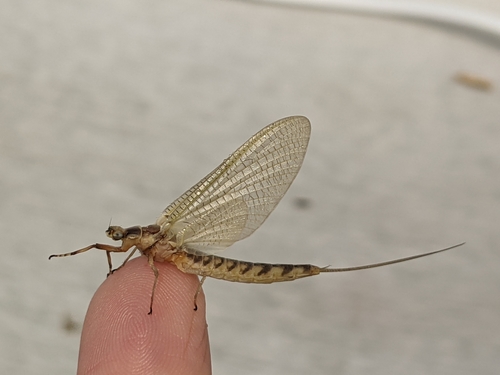
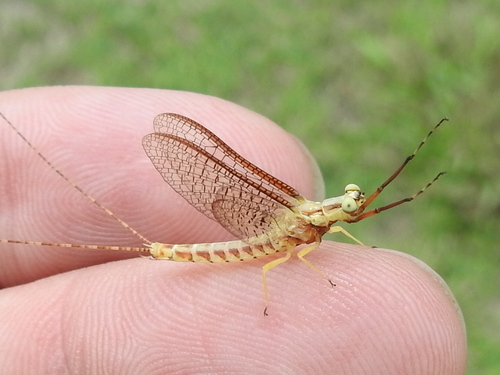
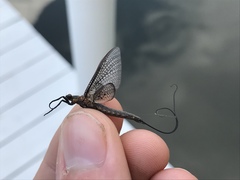
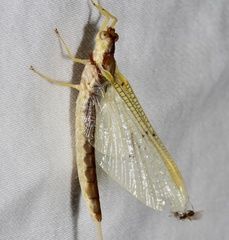
The giant mayfly can grow up to about 27 mm long as an adult. Adults are usually yellow, pale brown or white and have long forewings with smaller hind wings that have dark edges. They live near lakes and slow rivers, where nymphs burrow in muddy bottoms and adults swarm or rest on nearby vegetation.
Source: Wikipedia
How to recognize it
Forewings are long and membranous; hind wings are much smaller with dark margins. Body color varies but is typically a shade of yellow, pale brown, or white.
Source: Wikipedia
Size
Adults can reach up to 27 mm (about 1.1 in) in length.
Source: Wikipedia
Where it lives
Adults gather in swarms near water or rest in surrounding vegetation.
Source: Wikipedia
What it eats
Adult and subimago stages have no functional mouthparts and do not eat.
Source: Wikipedia
Life cycle
Nymphs hatch at about 1 mm long and molt up to thirty times as they grow. When ready, the nymph rises, becomes a subimago with cloudy wings, then after 1 to 3 days molts again to the sexually mature adult (imago).
Source: Wikipedia
When you see it
Emergence, known to anglers as the “hatch,” can be highly synchronized, producing massive swarms. Hatching peaks are notable but not strictly simultaneous across a region.
Source: Wikipedia
Where it comes from
Native to North America, widely distributed near lakes and slow rivers. Present in most of Canada and all U.S. states except Alaska and Arizona.
Source: Wikipedia
Where it is found in the US
Recorded in 44 of 51 states and DC. Most records: Illinois, Texas, Michigan, Ohio, Georgia, Vermont, Kansas, Minnesota.
Darker = more records. Counts are museum and citizen-science records, not population size.
Source: GBIF
Status: native in North America; native in Canada; native in United States. Source: iNaturalist
Months it is reported in the US
Source: GBIF
More photos
Questions people ask
When do giant mayflies appear?
They emerge in large, often synchronized swarms during the “hatch,” which shows a peak period but is not exactly simultaneous across an area.
Source: Wikipedia
Same family (Ephemeridae)

Sources
- Wikipedia: https://en.wikipedia.org/wiki/Hexagenia_limbata
Look it up elsewhere: GBIF · iNaturalist · BugGuide · ITIS · Wikipedia
Text written 2026-10-22 from the sources above and checked sentence by sentence against them. Data fetched 2026-10-22.