 Bug FAQ
European Green Drake
Ephemera danica · Order: Ephemeroptera · Family: Ephemeridae
Also called: Black Drake, British Green Drake, Green Drake, Grey Drake
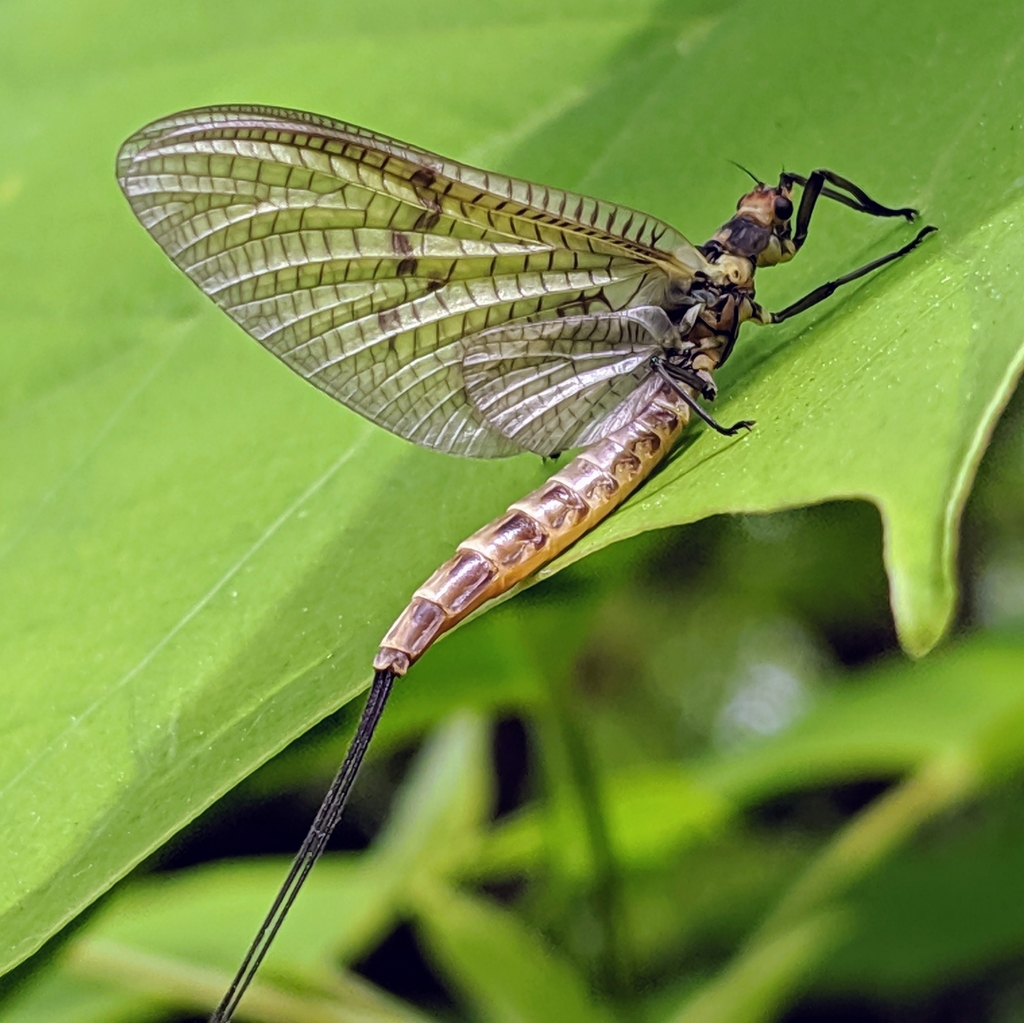
The European Green Drake is a mayfly that measures about 0.6 to 1.0 inches, with males around 0.6 to 0.8 in and females up to 1.0 in.
Source: Wikipedia
How to recognize it
They have three tail filaments and distinctive wing patterns to translucent wings with dark veins in the adult stage, and dull yellowish wings with brown veins as subimago.
Source: Wikipedia
Size
Males reach 15 to 20 mm and females 16 to 25 mm in length.
Source: Wikipedia
Where it lives
They live in clear rivers and lakes that have sandy or gravel bottoms across Europe, including the British Isles.
Source: Wikipedia
What it eats
Nymphs tunnel into river gravel and filter organic detritus for food. Adults are part of the aerial food web, serving as prey for swallows, trout, amphibians and spiders.
Source: Wikipedia
Life cycle
The species can spend one to three years as nymphs before emerging as adults. Adults appear mainly in May to June after the final larval stage.
Source: Wikipedia
When you see it
Adults are typically seen from April through November, with a peak in May to June.
Source: Wikipedia
Where it comes from
Their range covers most of Europe and the British Isles.
Source: Wikipedia
Lookalikes
It is the most commonly seen British Ephemeridae and is recognized by its three tails and wing markings.
Source: Wikipedia
Where it is found in the US
Recorded in 1 of 51 states and DC. Most records: Louisiana.
Darker = more records. Counts are museum and citizen-science records, not population size.
Source: GBIF
Questions people ask
When can I expect to see European Green Drake adults?
Adults are most abundant in May and June but may be present from April to November.
Source: Wikipedia
What do the nymphs eat?
Nymphs dig tunnels in river gravel and filter organic detritus for nutrition.
Source: Wikipedia
Same family (Ephemeridae)

Sources
- Wikipedia: https://en.wikipedia.org/wiki/Ephemera_danica
Look it up elsewhere: GBIF · iNaturalist · BugGuide · Wikipedia
Text written 2026-10-22 from the sources above and checked sentence by sentence against them. Data fetched 2026-10-22.