 Bug FAQ
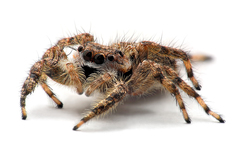
Four-lined Slender Jumping Spider
Marpissa lineata · Order: Araneae · Family: Salticidae

Females are a bit larger than males, measuring about 3.5 to 5.2 mm versus 3.0 to 4.0 mm for males. It lives in leaf litter and forest or shrub leaf-mould, and is also common in prairie grass litter. The spider is native to the eastern half of North America, recorded in many U.S. states such as Massachusetts, New York, Georgia and others.
Source: Wikipedia
How to recognize it
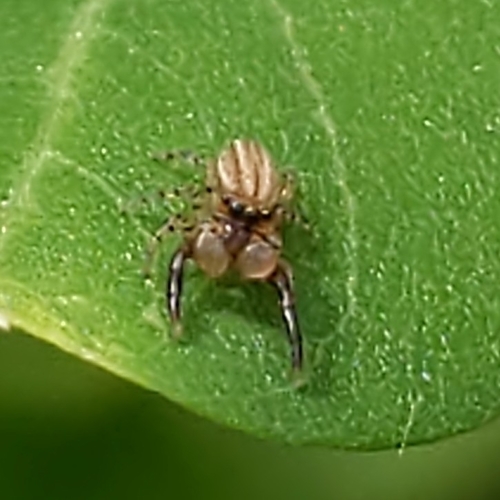
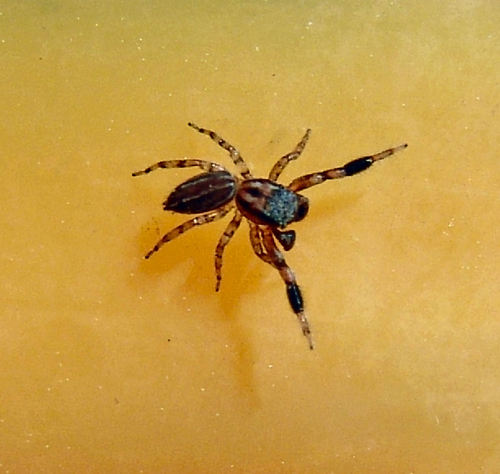
The carapace is brown with a thin black edge around it. The abdomen shows a dark central stripe that starts narrow at the front and widens toward the back.
Source: Wikipedia
Size
Females reach a total length of 3.5 to 5.2 mm, while males are slightly smaller at 3.0 to 4.0 mm.
Source: Wikipedia
Where it lives
It is commonly found in leaf mould within forest and shrub communities. It also occurs frequently in the litter layer of prairie grass habitats.
Source: Wikipedia
Where it is found in the US
Recorded in 36 of 51 states and DC. Most records: Texas, Ohio, Georgia, Illinois, Massachusetts, Pennsylvania, North Carolina, Colorado.
Darker = more records. Counts are museum and citizen-science records, not population size.
Source: GBIF
Status: native in North America; native in Canada. Source: iNaturalist
Months it is reported in the US
Source: GBIF
More photos

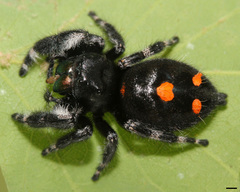
Same family (Salticidae)



Sources
- Wikipedia: https://en.wikipedia.org/wiki/Marpissa_lineata
Look it up elsewhere: GBIF · iNaturalist · BugGuide · ITIS · Wikipedia
Text written 2026-10-24 from the sources above and checked sentence by sentence against them. Data fetched 2026-10-24.