 Bug FAQ
Floury Baker
Aleeta curvicosta · Order: Hemiptera · Family: Cicadidae
Also called: Floury Miller
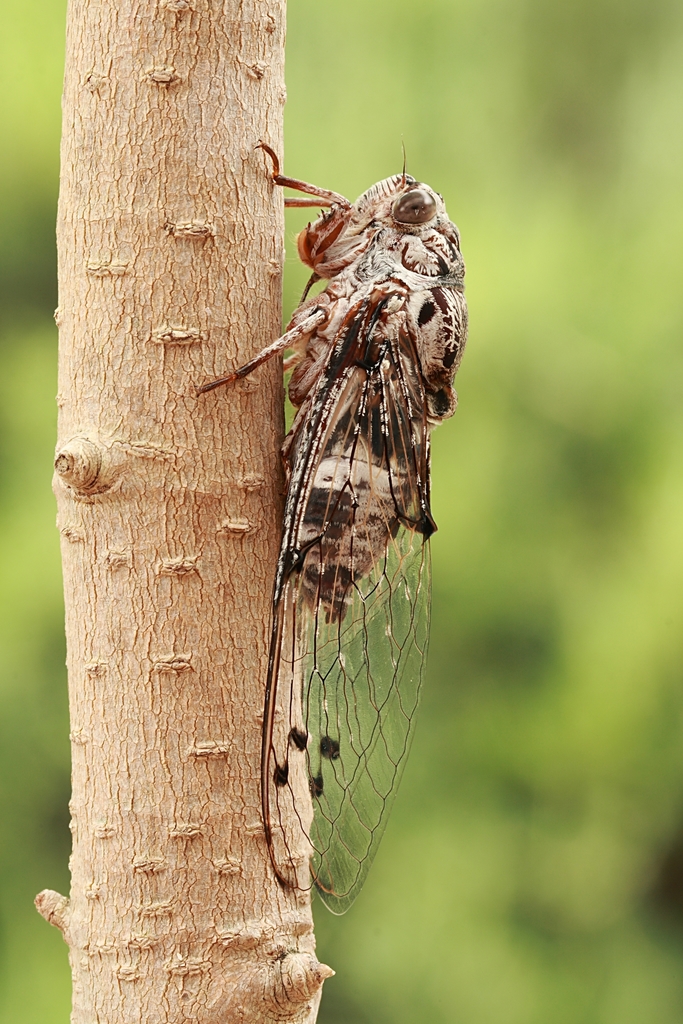
It lives on many trees, especially paperbark, emerges from the soil between late November and February and can be seen until May. It is a poor flier, is preyed on by cicada-killer wasps and birds, and may die from a cicada-specific fungal disease.
Source: Wikipedia
How to recognize it
Its body and eyes are brown with pale patterns and a light line down the middle of the pronotum.
Source: Wikipedia
Size
Body length is about 2.9 cm and forewings range from 3 to 5.1 cm, giving a wingspan of 9 to 10 cm. Individuals vary in size across regions depending on local rainfall.
Source: Wikipedia
Is it a pest in the house?
It is a poor flier and is preyed upon by cicada-killer wasps, birds, and can die from a cicada-specific fungus. It lives solitarily and occurs at low densities.
Source: Wikipedia
Does it bite or sting?
Cicada-killer wasps sting and paralyse cicadas high in the trees. Stung cicadas are placed in the wasp’s burrow to serve as food for developing wasp larvae.
Source: Wikipedia
How to get rid of it
It occurs solitarily and at low densities, so control is rarely needed. Being a poor flier, it is naturally kept in check by predators and fungal disease.
Source: Wikipedia
Where it lives
Found on many tree species, it prefers paperbark (Melaleuca) trees. It is a weak flier and is preyed upon by cicada-killer wasps, birds, and can be killed by a cicada-specific fungus.
Source: Wikipedia
What it eats
The floury baker lives solitarily and occurs at low densities.
Source: Wikipedia
When you see it
Emergence occurs from late November through late February, with sightings possible until May.
Source: Wikipedia
Where it comes from
It is native to the eastern coastline of the continent.
Source: Wikipedia
Lookalikes
It differs from the similar undescribed species A. sp. nr. curvicosta by male genitalia structure and a distinct call. Members of Aleeta and Tryella lack tymbal covers and have forewings whose costal margin widens toward the attachment point.
Source: Wikipedia
Questions people ask
When can I see floury bakers?
Adults emerge from late November to late February and may be observed until May.
Source: Wikipedia
How big are floury bakers?
They are about 3 cm long, with forewings 3 to 5 cm and a wingspan of roughly 9 to 10 cm.
Source: Wikipedia
Where do floury bakers live?
They are found on many trees, especially paperbark, along the eastern coastline.
Source: Wikipedia
Same family (Cicadidae)
Sources
- Wikipedia: https://en.wikipedia.org/wiki/Aleeta
Look it up elsewhere: GBIF · iNaturalist · BugGuide · Wikipedia
Text written 2026-10-23 from the sources above and checked sentence by sentence against them. Data fetched 2026-10-22.