 Bug FAQ
Florida Duskywing
Ephyriades brunnea · Order: Lepidoptera · Family: Hesperiidae
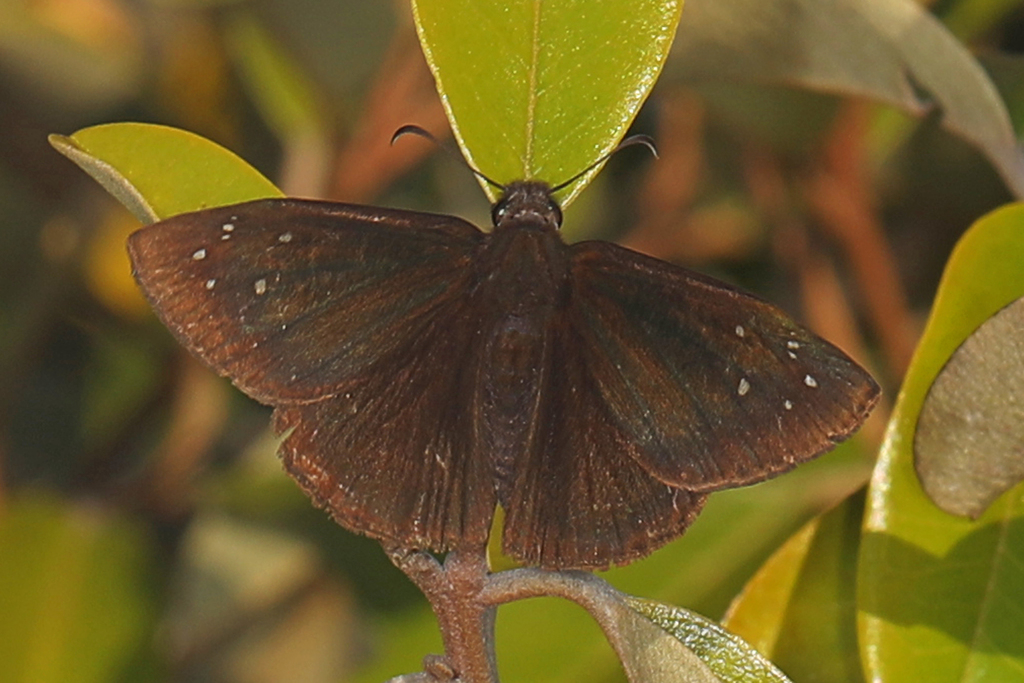
The Florida duskywing has a wingspan of about 1 ⅞ inches (48 mm). It lives in South Florida’s pine rockland habitats. Larvae feed on Barbados cherry, while adults sip nectar from wild coffee and several other plants.
Source: Wikipedia
How to recognize it
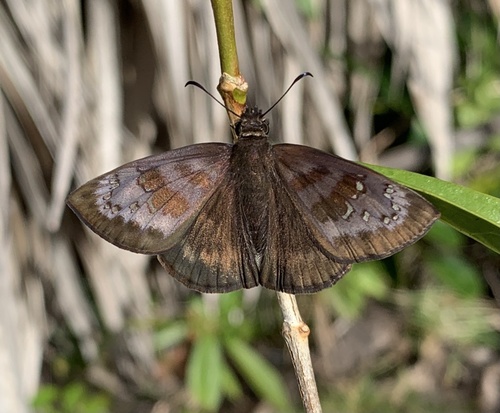
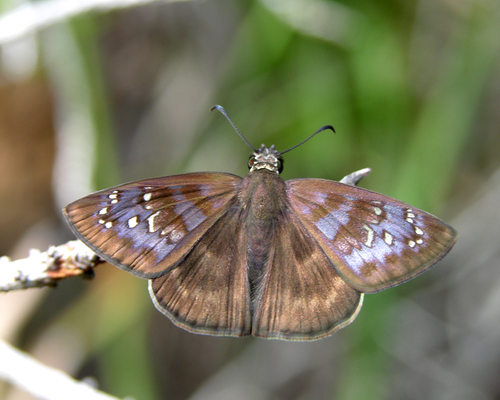
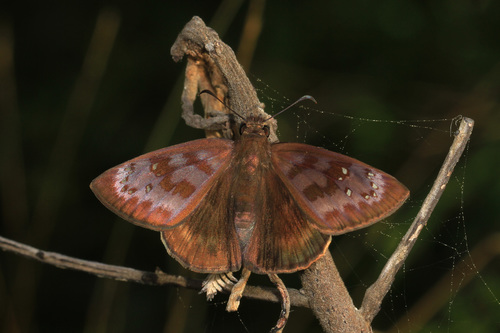
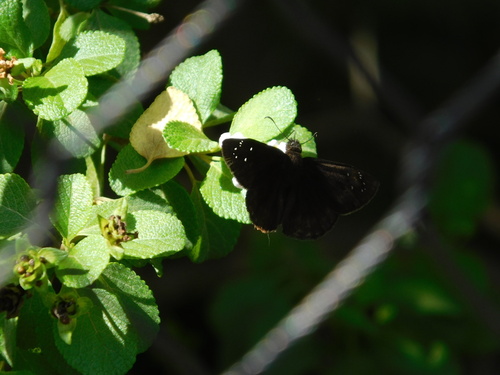
Males have dark brown dorsal wings with a sheen, a ring of white transparent spots near the apex, and a lighter brown margin on the hindwing. Females are brown with dark mottling, darker outer margins, and have larger, more numerous dorsal spots than males.
Source: Wikipedia
Size
Wingspan is roughly 1 ⅞ inches (48 mm).
Source: Wikipedia
Where it lives
Found in South Florida, especially in pine rockland areas.
Source: Wikipedia
What it eats
Caterpillars eat Barbados cherry (Malpighia emarginata). Adults obtain nectar from wild coffee, Bidens alba, Croton granduosus, and Lantana involucrata.
Source: Wikipedia
Life cycle
Larvae are sometimes parasitized by two species of parasitic wasps.
Source: Wikipedia
Where it comes from
Its range is limited to South Florida.
Source: Wikipedia
Where it is found in the US
Recorded in 3 of 51 states and DC. Most records: Florida, Kansas, North Carolina.
Darker = more records. Counts are museum and citizen-science records, not population size.
Source: GBIF
Status: introduced in Canada. Source: iNaturalist
Months it is reported in the US
Source: GBIF
More photos
Questions people ask
Where does the Florida duskywing live?
It is found in South Florida’s pine rockland habitats.
Source: Wikipedia
What do adult Florida duskywings drink?
Adults sip nectar from wild coffee and other plants such as Bidens alba, Croton granduosus, and Lantana involucrata.
Source: Wikipedia
How can I tell male and female Florida duskywings apart?
Males have a dark brown sheen with a ring of white spots near the wing tip, while females are brown with darker mottling and have larger, more numerous spots.
Source: Wikipedia
Same family (Hesperiidae)




Sources
- Wikipedia: https://en.wikipedia.org/wiki/Ephyriades_brunnea
Look it up elsewhere: GBIF · iNaturalist · BugGuide · ITIS · Wikipedia
Text written 2026-10-24 from the sources above and checked sentence by sentence against them. Data fetched 2026-10-24.