 Bug FAQ
Flamed Tarantula-hawk Wasp
Hemipepsis ustulata · Order: Hymenoptera · Family: Pompilidae
Source: Wikipedia
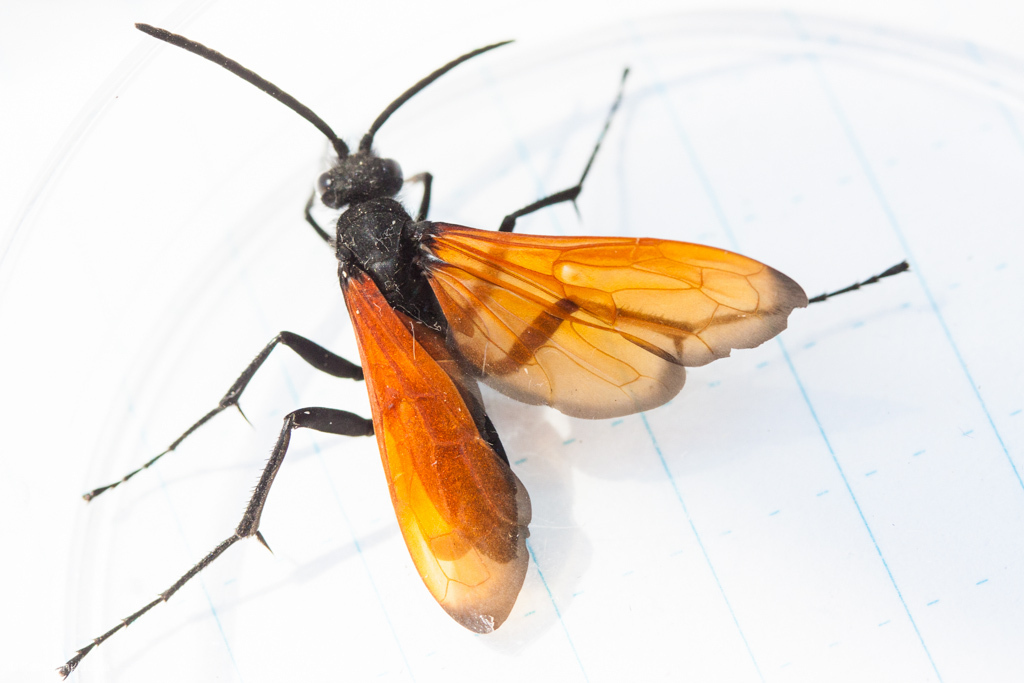
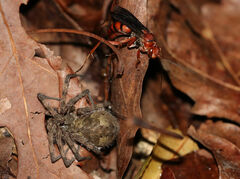
It can grow up to 5 cm long, making it one of the largest wasps. Its larvae develop by feeding on tarantulas.
Source: Wikipedia
How to recognize it
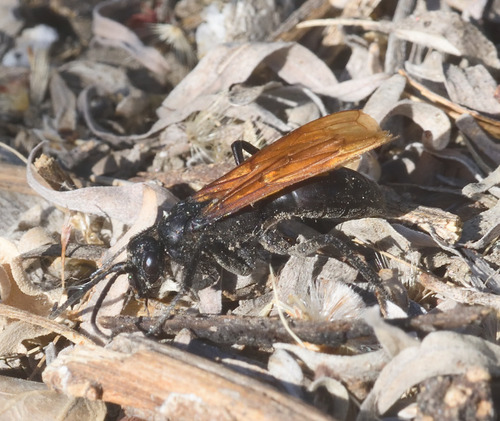
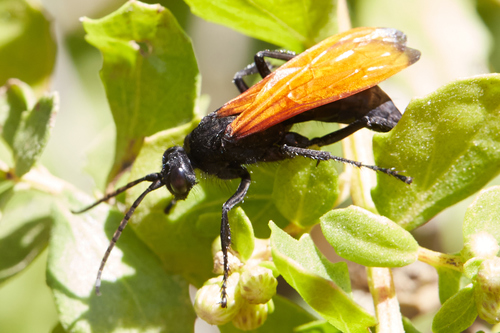
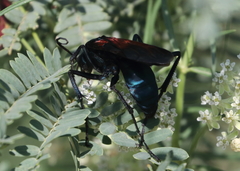
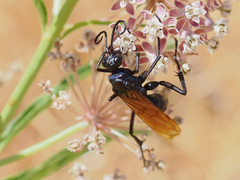
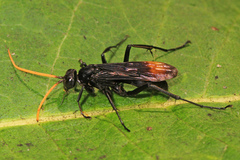
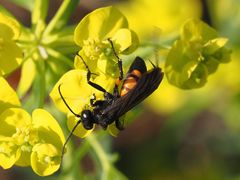
The body is matte black with rust-orange wings. Wing-vein patterns are the reliable way to separate it from similar species. A uniquely curved antenna with twelve segments helps confirm its identity.
Source: Wikipedia
Size
Adults can reach about 5 cm in length.
Source: Wikipedia
Can it bite, sting or make you sick?
Its sting is debilitating and deters almost all predators.
Source: Wikipedia
Where it lives
It thrives in the dry, arid regions of the Southwest USA.
Source: Wikipedia
What it eats
The larvae feed on tarantulas.
Source: Wikipedia
Life cycle
The egg is about 5 mm long, creamy white and gently curved. After hatching, the larva consumes the spider’s organs while keeping the spider alive as long as possible.
Source: Wikipedia
When you see it
Males often use palo verde trees as territorial landmarks. Territorial ownership changes frequently during the male flight season.
Source: Wikipedia
Where it comes from
Hemipepsis ustulata is native to the Southwestern United States.
Source: Wikipedia
Lookalikes
It resembles Pepsis wasps, which are more metallic black with deep-blue striped patterns.
Source: Wikipedia
Where it is found in the US
Recorded in 9 of 51 states and DC. Most records: California, Texas, Utah, New Mexico, Arizona, Colorado, Nevada, Idaho.
Darker = more records. Counts are museum and citizen-science records, not population size.
Source: GBIF
Status: native in North America; native in United States. Source: iNaturalist
Months it is reported in the US
Source: GBIF
More photos

Questions people ask
How painful is the sting?
The sting is debilitating and can be lethal depending on a person’s weight and body mass.
Source: Wikipedia
How can I tell them apart from similar wasps?
Wing-vein patterns and the uniquely curved twelve-segmented antenna are reliable identifiers.
Source: Wikipedia
Same family (Pompilidae)
Sources
- Wikipedia: https://en.wikipedia.org/wiki/Hemipepsis_ustulata
Look it up elsewhere: GBIF · iNaturalist · BugGuide · Wikipedia
Text written 2026-10-27 from the sources above and checked sentence by sentence against them. Data fetched 2026-10-27.