 Bug FAQ
Fire-tailed Scoliid Wasp
Triscolia ardens · Order: Hymenoptera · Family: Scoliidae
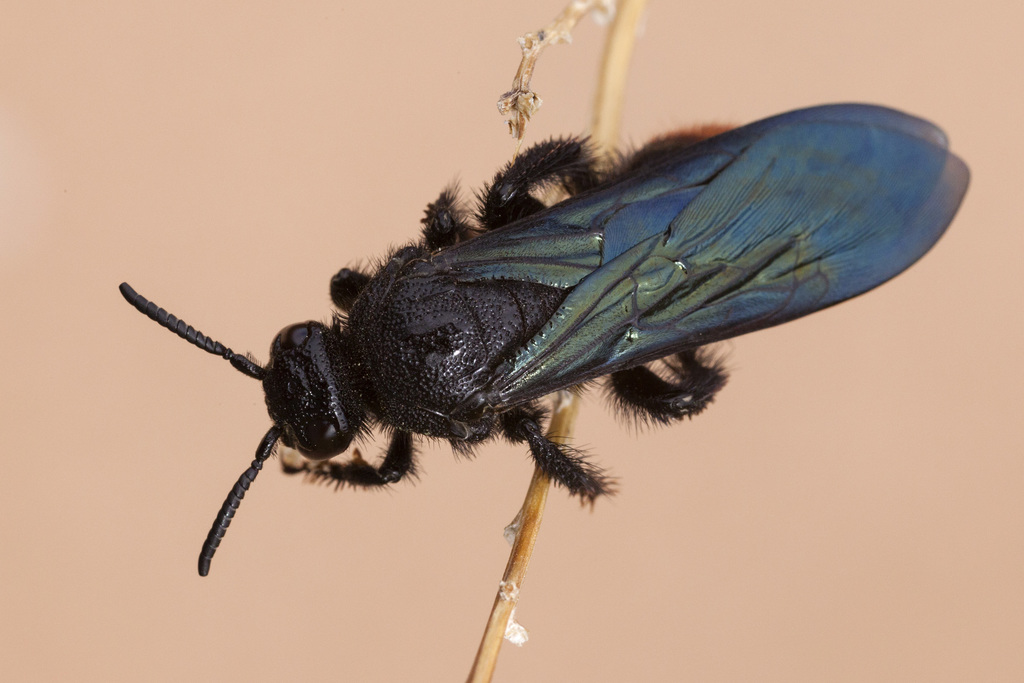
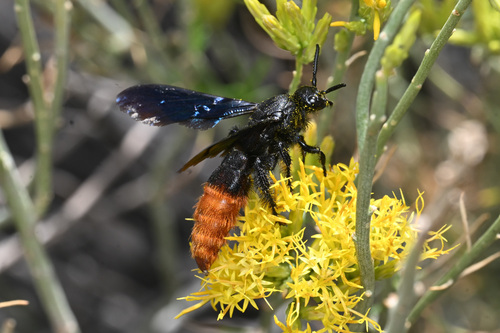
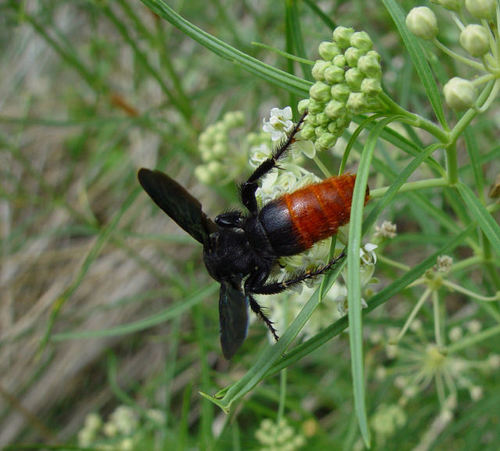
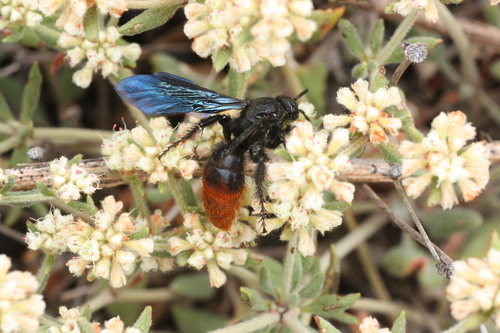
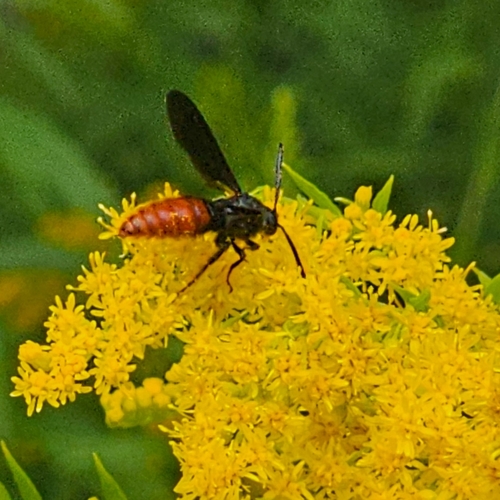
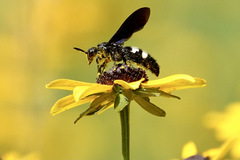
The fire-tailed scoliid wasp is mostly black with a red abdomen beyond the second segment. It lives in open fields and meadows from California to Texas and in several Mexican states, where it hunts ground-dwelling grubs.
Source: Wikipedia
How to recognize it
It looks like the common Scolia dubia but does not have the yellow spots that dubia normally shows.
Source: Wikipedia
Where it lives
It is found in open fields, meadows and other open areas, flying close to the ground while hunting.
Source: Wikipedia
What it eats
The female digs underground, finds a grub, stings it, lays an egg on it and seals the hole with a cell.
Source: Wikipedia
Life cycle
Its life cycle involves burrowing to locate a grub, stinging it, depositing an egg on the host and covering the site with a protective cell.
Source: Wikipedia
Where it comes from
In the United States it occurs from California eastward to Texas.
Source: Wikipedia
Lookalikes
It can be confused with Scolia dubia, but unlike that species it lacks the distinctive yellow spots.
Source: Wikipedia
Where it is found in the US
Recorded in 10 of 51 states and DC. Most records: Arizona, New Mexico, Texas, California, Utah, Arkansas, Nevada, South Carolina.
Darker = more records. Counts are museum and citizen-science records, not population size.
Source: GBIF
Status: native in North America; native in United States. Source: iNaturalist
Months it is reported in the US
Source: GBIF
More photos
Questions people ask
How can I tell a fire-tailed scoliid wasp apart from Scolia dubia?
Look at the abdomen: the fire-tailed wasp has a red rear abdomen and no yellow spots, while Scolia dubia shows yellow spots on its body.
Source: Wikipedia
Same family (Scoliidae)

Sources
- Wikipedia: https://en.wikipedia.org/wiki/Triscolia_ardens
Look it up elsewhere: GBIF · iNaturalist · BugGuide · Wikipedia
Text written 2026-10-24 from the sources above and checked sentence by sentence against them. Data fetched 2026-10-24.