 Bug FAQ
Scolia hirta
Scolia hirta · Order: Hymenoptera · Family: Scoliidae

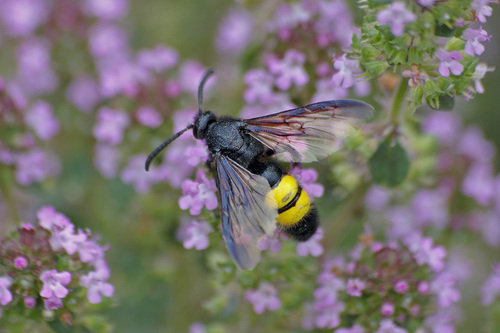
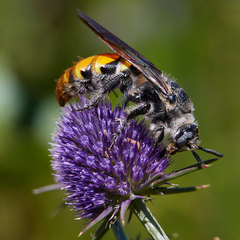
Adult Scolia hirta are 10 to 25 mm long and entirely black with two yellow stripes on the abdomen and smoky-dark wings that show blue reflections. They are found from July to September on cyan or blue flowers and composite inflorescences across Mediterranean and central Europe, the eastern Palearctic, the Near East and North Africa.
Source: Wikipedia
Size
Adults grow to 10 to 25 mm (0.39 to 0.98 in) in length.
Source: Wikipedia
Where it lives
They can be seen from July through September feeding on flowers, especially those that appear cyan or blue and on composite or clustered blooms.
Source: Wikipedia
What it eats
Females dig in the ground to locate scarab beetle larvae, especially Cetoniinae such as Cetonia aurata. Adults also feed on flowers during their active months.
Source: Wikipedia
Life cycle
After finding a scarab larva, the female wasp stings it to cause permanent paralysis, lays an egg on it, and the hatching wasp larva consumes the immobilized host.
Source: Wikipedia
When you see it
They are active from July through September.
Source: Wikipedia
Where it comes from
The species occurs in most of Mediterranean and central Europe, the eastern Palearctic realm, the Near East, and North Africa.
Source: Wikipedia
Lookalikes
It resembles Scolia sexmaculata, which has two or three yellow spots instead of the two stripes seen in S. hirta.
Source: Wikipedia
More photos
Questions people ask
Are they a garden pest?
They hunt scarab beetle larvae, not garden plants, and feed on flowers.
Source: Wikipedia
Same family (Scoliidae)

Sources
- Wikipedia: https://en.wikipedia.org/wiki/Scolia_hirta
Look it up elsewhere: GBIF · iNaturalist · BugGuide · Wikipedia
Text written 2026-10-22 from the sources above and checked sentence by sentence against them. Data fetched 2026-10-22.