 Bug FAQ
Blue-winged Scoliid Wasp
Scolia dubia · Order: Hymenoptera · Family: Scoliidae
Also called: Blue-winged Wasp

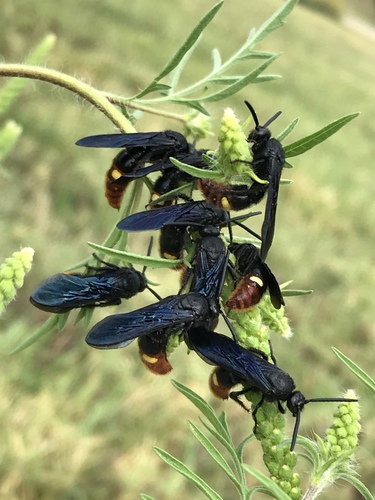
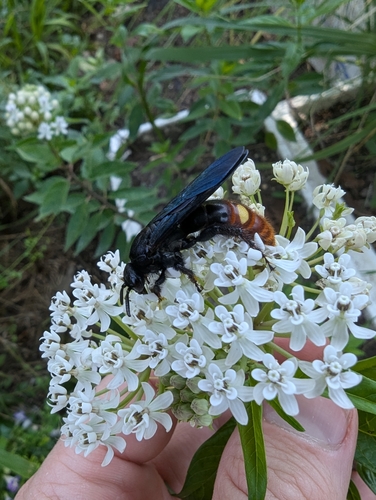
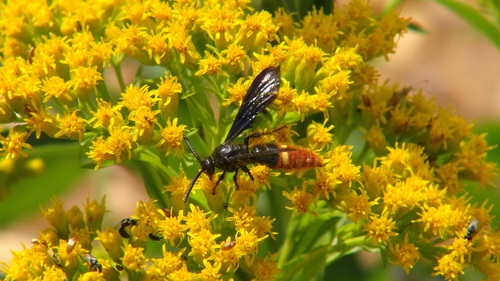
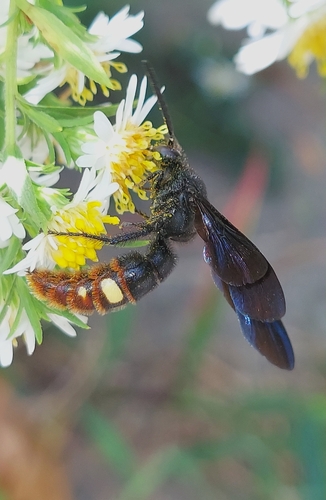
The blue-winged scoliid wasp is a black wasp with a red abdomen and measures about 2 to 2.5 cm long. Adults drink flower nectar from midsummer through early fall, while females hunt beetle grubs in the soil.
Source: Wikipedia
Size
It is about 2.0 to 2.5 cm (0.8 to 1.0 in) long.
Source: Wikipedia
What it eats
Females dig in the ground to find beetle larvae, especially green June beetle grubs and possibly Japanese beetle larvae. Adults sip nectar from flowers from July through September or October.
Source: Wikipedia
Life cycle
The larva pupates inside its beetle host and overwinters there.
Source: Wikipedia
When you see it
Adults are active and feeding on nectar from July to September or October.
Source: Wikipedia
Where it comes from
It occurs from New England to Florida, west to California, and its southern range reaches Coahuila, Mexico.
Source: Wikipedia
Lookalikes
The subspecies S. dubia haematodes looks similar to Triscolia ardens but can be told apart by having only two submarginal cells in the forewing.
Source: Wikipedia
Where it is found in the US
Recorded in 37 of 51 states and DC. Most records: New York, Pennsylvania, Virginia, Maryland, North Carolina, Georgia, Ohio, Illinois.
Darker = more records. Counts are museum and citizen-science records, not population size.
Source: GBIF
Status: native in North America; native in United States. Source: iNaturalist
Months it is reported in the US
Source: GBIF
More photos
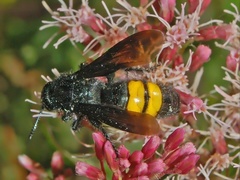
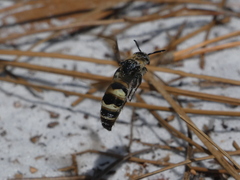
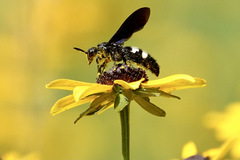
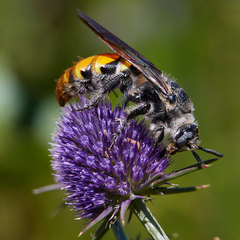
Same family (Scoliidae)

Sources
- Wikipedia: https://en.wikipedia.org/wiki/Scolia_dubia
Look it up elsewhere: GBIF · iNaturalist · BugGuide · ITIS · Wikipedia
Text written 2026-10-22 from the sources above and checked sentence by sentence against them. Data fetched 2026-10-22.