 Bug FAQ
Festoon
Apoda limacodes · Order: Lepidoptera · Family: Limacodidae


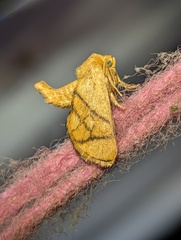
Adult festoon moths have a wingspan of about 24 to 28 millimetres. They are mainly active at night but will sometimes fly during the day. The species lives in dense woodlands throughout most of Europe.
Source: Wikipedia
How to recognize it
Festoon moths are primarily nocturnal, though they may be seen flying in daylight on occasion.
Source: Wikipedia
Size
Adults have a wingspan ranging from 24 to 28 mm.
Source: Wikipedia
Where it lives
They mainly inhabit thick woodlands.
Source: Wikipedia
What it eats
The larvae feed on oak and beech trees.
Source: Wikipedia
Life cycle
The caterpillars are small and grub-like. Their cocoons are unattached, overwinter, and pupate in spring.
Source: Wikipedia
When you see it
Adults usually fly between June and July.
Source: Wikipedia
Where it comes from
The moth is found across most of Europe.
Source: Wikipedia
More photos


Questions people ask
Are they nocturnal?
Yes, they are mainly nocturnal but can be seen flying during the day sometimes.
Source: Wikipedia
Same family (Limacodidae)
 Saddleback Caterpillar MothAcharia stimuleaCan sting
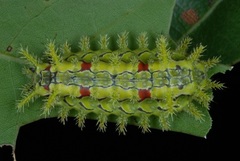 Spiny Oak-slug MothEuclea delphiniiVenomous
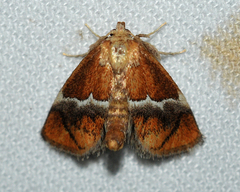 Yellow-shouldered Slug MothLithacodes fasciolaDamages trees, gardens or crops
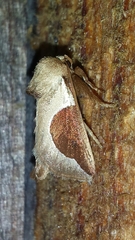 Skiff MothProlimacodes badiaDamages trees, gardens or crops
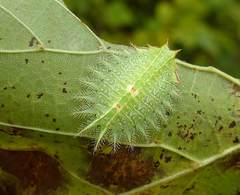 Crowned Slug MothIsa textulaDamages trees, gardens or crops
 Yellow-collared Slug MothApoda y-inversaDamages trees, gardens or crops
Sources
- Wikipedia: https://en.wikipedia.org/wiki/Apoda_limacodes
Look it up elsewhere: GBIF · iNaturalist · BugGuide · Wikipedia
Text written 2026-10-23 from the sources above and checked sentence by sentence against them. Data fetched 2026-10-22.