 Bug FAQ
Spiny Oak-slug Moth
Euclea delphinii · Order: Lepidoptera · Family: Limacodidae
Also called: Spiny Slug Caterpillar
Source: Wikipedia

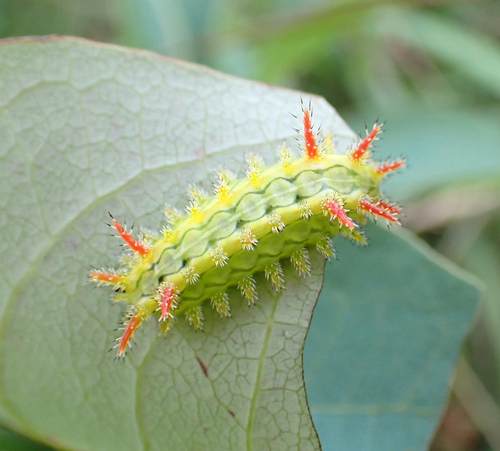
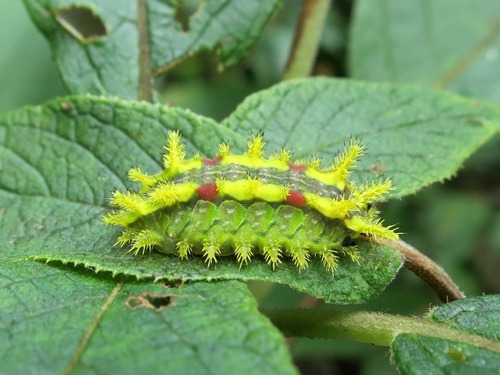
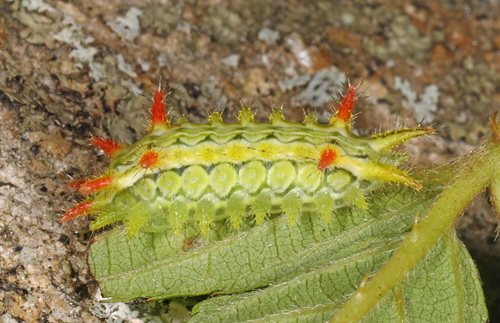
The caterpillar is a small, hairy brown moth larva with yellow-green colour and bright red square marks on its back, and it bears spiny tubercles along its sides. It feeds on many deciduous trees and shrubs and is found mainly from late June to October, with adults flying from April to September.
Source: Wikipedia
How to recognize it
The larva is usually yellow-green with bright red square markings on its back, which is a key ID feature. Its body is flattened, oval and covered with spiny bumps along the back and sides.
Source: Wikipedia
Size
The adult moth reaches up to about 20 mm in length. The moth is roughly 1 cm long, hairy, brown, and has small green patches on the upper wings.
Source: Wikipedia
Does it bite or sting?
The caterpillar’s venom can cause mild itching and burning or, in some cases, more serious reactions that need medical care.
Source: Wikipedia
Where it lives
It is the only species of its genus recorded in West Virginia. Its caterpillars are often mistaken for other species in the same genus, especially Parasa.
Source: Wikipedia
What it eats
Caterpillars eat a wide variety of deciduous trees and shrubs, including apple, oak, maple, birch and many others.
Source: Wikipedia
Life cycle
Further south, such as in Missouri, there are two or more generations each year.
Source: Wikipedia
When you see it
Caterpillars are most common from June through October, while adults appear from April to September. In the eastern United States there is typically one generation of caterpillars each year, active late June to October.
Source: Wikipedia
Where it comes from
Its range extends from eastern Minnesota to Maine and New Brunswick, with the highest concentrations in West Virginia. The spiny oak-slug is the larval stage of a Limacodidae moth.
Source: Wikipedia
Lookalikes
These caterpillars are often confused with other members of their genus, especially Parasa species. Parasa moths have larger green patches on the forewings, while Euclea delphinii shows smaller green spots and more brown.
Source: Wikipedia
Where it is found in the US
Recorded in 36 of 51 states and DC. Most records: Massachusetts, Ohio, Florida, New York, Pennsylvania, Vermont, Michigan, North Carolina.
Darker = more records. Counts are museum and citizen-science records, not population size.
Source: GBIF
Status: native in North America; native in United States; native in Canada. Source: iNaturalist
Months it is reported in the US
Source: GBIF
More photos
Questions people ask
What trees do they eat?
They feed on many deciduous trees and shrubs such as oak, maple, birch, apple and others.
Source: Wikipedia
When can I see them?
Caterpillars appear from late June through October, and the adult moths fly from April to September.
Source: Wikipedia
How can I tell them apart from similar caterpillars?
Look for yellow-green bodies with bright red square marks and spiny tubercles; other similar species lack this exact pattern.
Source: Wikipedia
Same family (Limacodidae)
 Saddleback Caterpillar MothAcharia stimuleaCan sting
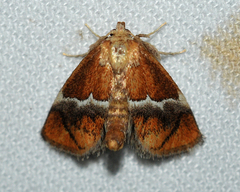 Yellow-shouldered Slug MothLithacodes fasciolaDamages trees, gardens or crops
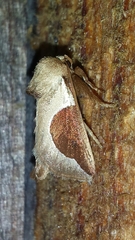 Skiff MothProlimacodes badiaDamages trees, gardens or crops
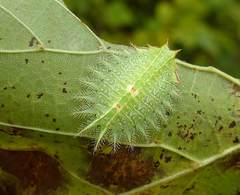 Crowned Slug MothIsa textulaDamages trees, gardens or crops
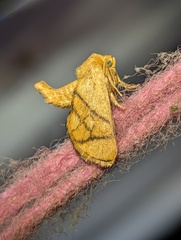 Yellow-collared Slug MothApoda y-inversaDamages trees, gardens or crops
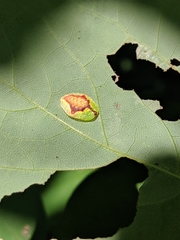 Early Button Slug MothTortricidia testacea
Sources
- Wikipedia: https://en.wikipedia.org/wiki/Spiny_oak_slug
Look it up elsewhere: GBIF · iNaturalist · BugGuide · ITIS · Wikipedia
Text written 2026-10-22 from the sources above and checked sentence by sentence against them. Data fetched 2026-10-22.