 Bug FAQ
Evening Cicada
Tanna japonensis · Order: Hemiptera · Family: Cicadidae

Male evening cicadas are 28 to 38 mm long and females 21 to 25 mm long. They are reddish-brown with green around the eyes and on the thorax, and males have a noticeably longer, thicker abdomen than females. In Japan they live from Hokkaido’s cool mountains to the subtropical forests of Amami Ōshima, preferring cypress, cedar and hardwood woods.
Source: Wikipedia
How to recognize it
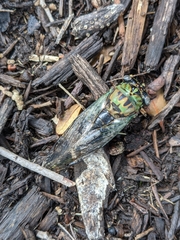
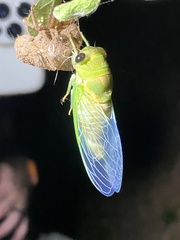
The body is reddish-brown with green near the compound eye and on the central thorax. Males have a longer, thicker abdomen than females, making the sexes easy to tell apart.
Source: Wikipedia
Size
Adult males measure 28 to 38 mm in length, while females are 21 to 25 mm long.
Source: Wikipedia
Where it lives
They inhabit a wide range of Japanese habitats, from temperate Hokkaido to subtropical islands near Taiwan. Typical sites are cypress, cedar and hardwood forests, both in mountains and lower elevations of northern and southern Kyūshū.
Source: Wikipedia
What it eats
The parasitic moth Epipomponia nawai lays its eggs on this cicada, using it as a host. Flesh flies also attack the cicada.
Source: Wikipedia
Life cycle
Their loud calls are heard mainly in autumn, though in some areas they can start at the end of summer. From September through mid-October they may be heard almost daily.
Source: Wikipedia
When you see it
The peak listening period is autumn, with some regions hearing them from late summer. Their calls are common each day between September and mid-October.
Source: Wikipedia
Questions people ask
When are evening cicadas most audible?
They are heard most often from September to mid-October, with daily calls during that span.
Source: Wikipedia
How can I tell male from female cicadas?
Males have a longer and thicker abdomen than females, which is an easy visual cue.
Source: Wikipedia
Same family (Cicadidae)
Sources
- Wikipedia: https://en.wikipedia.org/wiki/Tanna_japonensis
Look it up elsewhere: GBIF · iNaturalist · BugGuide · Wikipedia
Text written 2026-10-23 from the sources above and checked sentence by sentence against them. Data fetched 2026-10-23.