 Bug FAQ
Elm Sphinx
Ceratomia amyntor · Order: Lepidoptera · Family: Sphingidae
Also called: Four-horned Sphinx, Elm Sphinx Moth
Source: Wikipedia

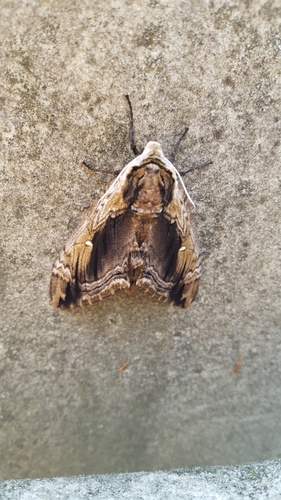
Adult elm sphinx moths have a gray-brown forewing with wavy markings and three dark bands along the body. They are medium sized, with a wingspan of about 8 to 11 cm, and a small white dot near the centre of each forewing. In the north they appear once a year in June-July, while farther south they may have two or more generations, up to five in Louisiana.
Source: Wikipedia
How to recognize it
The adult’s forewings are gray-brown with wavy patterns and three broken dark bands run from the thorax to the abdomen tip. A small white dot is present in the upper centre of each forewing, and some individuals show a bright white splash on the head and wings.
Source: Wikipedia
Size
Wingspan ranges from about 8.2 cm to 11.5 cm.
Source: Wikipedia
Where it lives
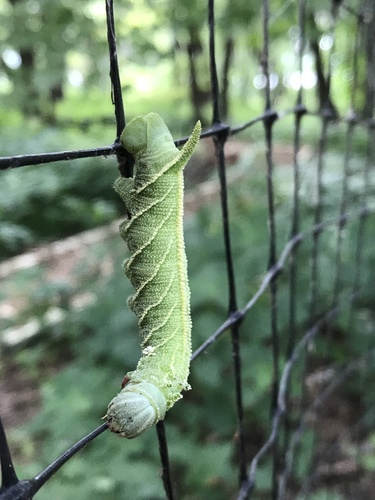
When ready to pupate, the caterpillars crawl down the host tree, go underground and may overwinter there.
Source: Wikipedia
What it eats
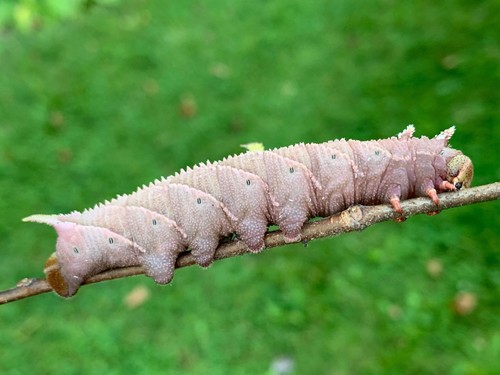
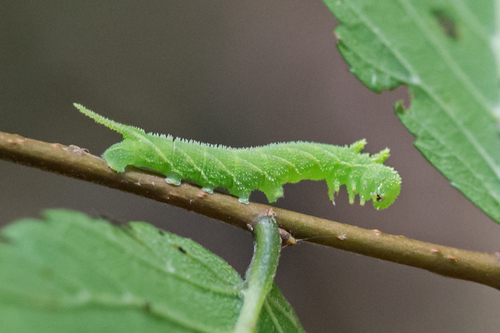
Caterpillars feed on elm leaves and also on birch, basswood and cherry.
Source: Wikipedia
Life cycle
Adults emerge as a single brood in northern areas from June to July. Further south there are two broods, and in Louisiana up to five broods can occur from March to October.
Source: Wikipedia
When you see it
In the north adults fly in June-July; farther south they appear later and may have multiple generations.
Source: Wikipedia
Where it comes from
It occurs across much of North America, from Nova Scotia west to Alberta and north-western US states, and down to Florida, the Gulf Coast, Texas, Louisiana and New Mexico.
Source: Wikipedia
Lookalikes
The small white dot on the forewing helps distinguish it from other moths, though some look similar. A bright white splash on the head and wings can make certain specimens stand out from typical elm sphinx moths.
Source: Wikipedia
Where it is found in the US
Recorded in 43 of 51 states and DC. Most records: Ohio, Texas, Michigan, Pennsylvania, New York, Illinois, Virginia, North Carolina.
Darker = more records. Counts are museum and citizen-science records, not population size.
Source: GBIF
Status: native in North America; native in Canada; native in United States. Source: iNaturalist
Months it is reported in the US
Source: GBIF
More photos
Questions people ask
What trees do elm sphinx caterpillars eat?
They feed on elm leaves and can also eat birch, basswood and cherry.
Source: Wikipedia
When are adult elm sphinx moths active?
In northern areas they fly once a year in June-July; farther south they may have two or more broods, up to five in Louisiana.
Source: Wikipedia
How can I recognize an adult elm sphinx moth?
Look for a gray-brown forewing with wavy markings, three dark body bands, a small white dot on each forewing, and a wingspan of about 8-12 cm.
Source: Wikipedia
Same family (Sphingidae)
 White-lined SphinxHyles lineataDamages trees, gardens or crops
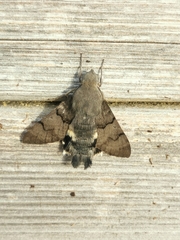 Eurasian Hummingbird HawkmothMacroglossum stellatarum
 Snowberry ClearwingHemaris diffinis
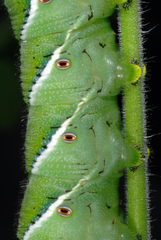 Carolina SphinxManduca sextaDamages trees, gardens or crops
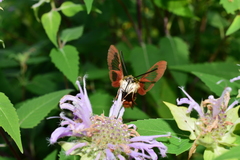 Hummingbird ClearwingHemaris thysbeDamages trees, gardens or crops
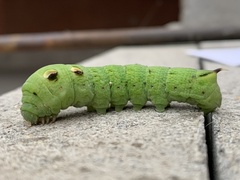 Elephant HawkmothDeilephila elpenor
Sources
- Wikipedia: https://en.wikipedia.org/wiki/Ceratomia_amyntor
Look it up elsewhere: GBIF · iNaturalist · BugGuide · ITIS · Wikipedia
Text written 2026-10-23 from the sources above and checked sentence by sentence against them. Data fetched 2026-10-23.