 Bug FAQ
Elm Leaf Beetle
Xanthogaleruca luteola · Order: Coleoptera · Family: Chrysomelidae
Source: Wikipedia
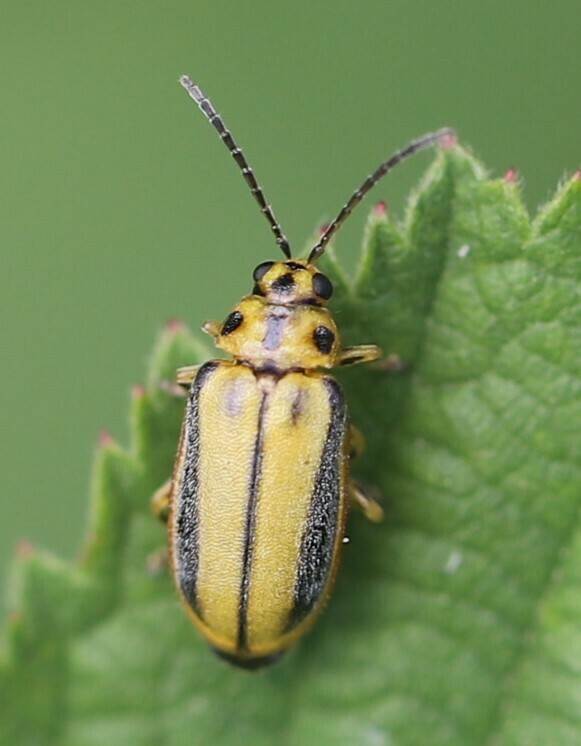
Adults are 6 to 8 mm long, yellow-green with a head spot, hourglass mark, two pronotum spots, and a dark stripe on each wing cover. Both adults and larvae eat the emerging leaves of elm trees, which can harm the trees in gardens and streets.
Source: Wikipedia
How to recognize it
The beetle ranges from yellow to green, has a spot on its head, an hourglass shape, two spots on the pronotum, and a dark stripe along each elytron edge.
Source: Wikipedia
Size
An adult beetle measures 6 to 8 mm in length. Larvae are under 13 mm long, usually black or black-and-yellow with rows of dots on the back and sides.
Source: Wikipedia
Is it a pest in the house?
Overwintering beetles may enter homes near infested elms, so sealing exterior cracks is advised.
Source: Wikipedia
How to get rid of it
Standard insecticide sprays are usually too late to be effective once damage is visible. Banding tree trunks with insecticide can reduce next year’s larvae by killing them as they descend before hibernation.
Source: Wikipedia
Where it lives
Overwintering adults can enter homes close to an elm infestation.
Source: Wikipedia
What it eats
Both adults and larvae feed on the new leaves of elm trees.
Source: Wikipedia
Life cycle
Eggs hatch in about a week and the larvae start feeding on the leaf undersides. Larvae develop for two to three weeks, then move down the tree to pupate in bark crevices.
Source: Wikipedia
When you see it
Beetles become active in spring when temperatures rise above 11 °C (52 °F).
Source: Wikipedia
Where it comes from
The species is native to Europe but has become invasive elsewhere.
Source: Wikipedia
Where it is found in the US
Recorded in 36 of 51 states and DC. Most records: Texas, New York, California, Colorado, New Mexico, Oklahoma, Arizona, Washington.
Darker = more records. Counts are museum and citizen-science records, not population size.
Source: GBIF
Status: introduced in North America; introduced in United States. Source: iNaturalist
Months it is reported in the US
Source: GBIF
More photos


Questions people ask
How can I prevent them from entering my house?
Seal all cracks and openings around the exterior of the house to keep overwintering beetles out.
Source: Wikipedia
What damage do they cause to my garden?
They chew the new leaves of elm trees, which can weaken the trees and reduce their ornamental value.
Source: Wikipedia
Same family (Chrysomelidae)
 Spotted Cucumber BeetleDiabrotica undecimpunctataDamages trees, gardens or crops
 Bean WeevilAcanthoscelides obtectusDamages trees, gardens or crops
 Cowpea WeevilCallosobruchus maculatusDamages trees, gardens or crops
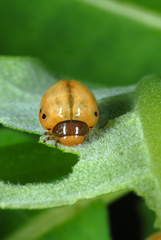 Swamp Milkweed Leaf BeetleLabidomera clivicollisDamages trees, gardens or crops
 Alder Leaf BeetleAgelastica alniDamages trees, gardens or crops
 Dogbane Leaf BeetleChrysochus auratus
Sources
- Wikipedia: https://en.wikipedia.org/wiki/Elm_leaf_beetle
Look it up elsewhere: GBIF · iNaturalist · BugGuide · ITIS · Wikipedia
Text written 2026-10-22 from the sources above and checked sentence by sentence against them. Data fetched 2026-10-22.