 Bug FAQ
Eastern Double Drummer
Thopha saccata · Order: Hemiptera · Family: Cicadidae
Also called: Double Drummer
Source: Wikipedia

The Eastern Double Drummer is the largest Australian cicada, reaching about 5 cm in length and a wingspan over 13 cm. Adults perch high in eucalypt canopies in sclerophyll forests of Queensland and New South Wales and emerge from the ground between November and March, living for four to five weeks. Females cut slits in eucalypt branches to lay eggs, which can cause noticeable bark damage.
Source: Wikipedia
How to recognize it
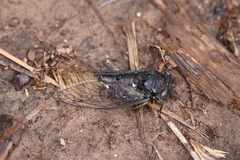
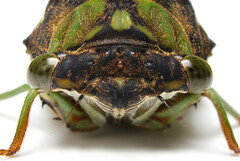
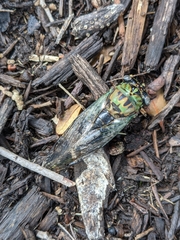
They have a broad head, brown body with a black thorax pattern, and red-brown and black underside.
Source: Wikipedia
Size
Males average 4.75 cm and females 5.12 cm in length. The biggest recorded specimen had a 15.1 cm wingspan; the average wingspan is about 13.3 cm.
Source: Wikipedia
Is it a pest in the house?
Females lay narrow spindle-shaped eggs in slits cut into eucalypt branches or twigs.
Source: Wikipedia
Where it lives
They live in sclerophyll forests of Queensland and New South Wales, usually perched high in large eucalypts. Nymphs develop underground for several years before emerging.
Source: Wikipedia
What it eats
Adult cicadas are preyed on by birds, foxes, and the cicada-killer wasp Exeirus lateritius.
Source: Wikipedia
Life cycle
Adults emerge from the ground between November and March and live for about four to five weeks. Nymphs typically spend four to six years underground before emerging.
Source: Wikipedia
When you see it
They appear in large numbers some years and may be absent in others.
Source: Wikipedia
Where it comes from
First described by Fabricius in 1803, it is native to Australia. Its range includes Queensland and New South Wales sclerophyll forests.
Source: Wikipedia
Lookalikes
It is larger and darker than the northern double drummer (T. sessiliba), which has a white abdominal band; the double drummer has black markings on the forewing costa.
Source: Wikipedia
More photos


Questions people ask
How can I tell a double drummer apart from the northern double drummer?
The double drummer is bigger, darker, and has black markings on the forewing edge, while the northern species shows a white band on the abdomen.
Source: Wikipedia
When do double drummers appear?
Adults emerge from November to March and are present for about four to five weeks.
Source: Wikipedia
Do they damage trees?
Yes, the egg-laying cuts made by females can damage the bark of eucalypt trees.
Source: Wikipedia
Same family (Cicadidae)


Sources
- Wikipedia: https://en.wikipedia.org/wiki/Thopha_saccata
Look it up elsewhere: GBIF · iNaturalist · BugGuide · Wikipedia
Text written 2026-10-23 from the sources above and checked sentence by sentence against them. Data fetched 2026-10-22.