 Bug FAQ
Doubleday's Notocelia Moth
Notocelia rosaecolana · Order: Lepidoptera · Family: Tortricidae
Also called: Common Rose Bell Moth, Common Rose Bell
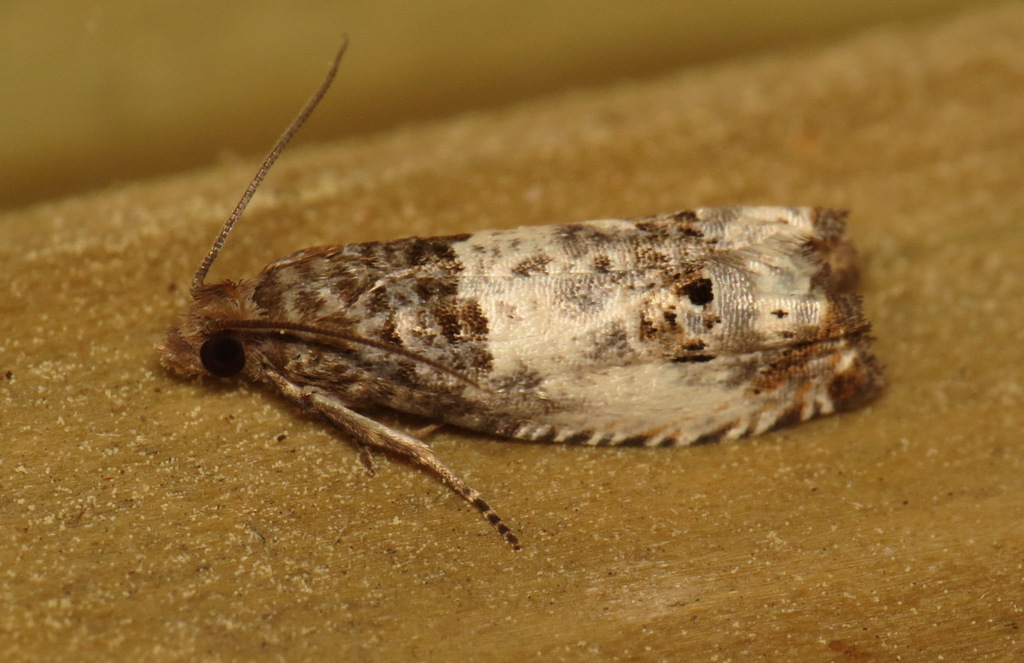
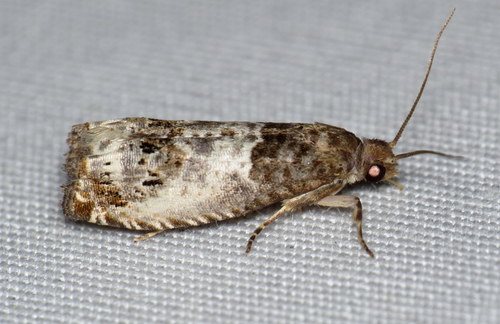
The Notocelia rosaecolana moth has a wingspan of about 15 to 20 mm and white forewings with dark streaks along the leading edge. Adults fly from late May through August in western Europe, and the larvae feed on several rose species.
Source: Wikipedia
How to recognize it
The forewings are broadened, the front edge is moderately arched, and the wing fold stops before the middle. The wings are white with fine dark brown streaks along the leading edge.
Source: Wikipedia
Size
The moth’s wingspan ranges from 15 to 20 mm.
Source: Wikipedia
Where it lives
It is found throughout the Palearctic realm.
Source: Wikipedia
What it eats
Caterpillars feed on various roses such as Rosa multiflora, Rosa davurica and Rosa rugosa.
Source: Wikipedia
When you see it
The flight period spans late May through August in western Europe.
Source: Wikipedia
Lookalikes
It looks similar to Notocelia trimaculana and Notocelia roborana.
Source: Wikipedia
Where it is found in the US
Recorded in 26 of 51 states and DC. Most records: New York, Pennsylvania, Maryland, North Carolina, Ohio, Massachusetts, Virginia, Michigan.
Darker = more records. Counts are museum and citizen-science records, not population size.
Source: GBIF
Status: introduced in Canada; introduced in United States. Source: iNaturalist
Months it is reported in the US
Source: GBIF
More photos
Questions people ask
When can I see adult Notocelia rosaecolana moths?
Adults are active from late May through August in western Europe.
Source: Wikipedia
What other moths might I confuse with this species?
It can be mistaken for Notocelia trimaculana or Notocelia roborana.
Source: Wikipedia
Same family (Tortricidae)
 Oblique-banded Leafroller MothChoristoneura rosaceanaDamages trees, gardens or crops
 Garden TortrixClepsis peritanaDamages trees, gardens or crops
 Common MarbleSyricoris lacunanaDamages trees, gardens or crops
 Red-banded Leafroller MothArgyrotaenia velutinanaDamages trees, gardens or crops
 Light Brown Apple MothEpiphyas postvittanaDamages trees, gardens or crops
 Aster and Reddish Eucosma Moths and AlliesEucosma parmatana
Sources
- Wikipedia: https://en.wikipedia.org/wiki/Notocelia_rosaecolana
Look it up elsewhere: GBIF · iNaturalist · BugGuide · Wikipedia
Text written 2026-10-24 from the sources above and checked sentence by sentence against them. Data fetched 2026-10-24.