 Bug FAQ
Dichomeris simpliciella
Dichomeris simpliciella · Order: Lepidoptera · Family: Gelechiidae

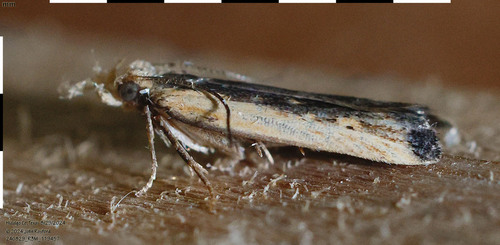
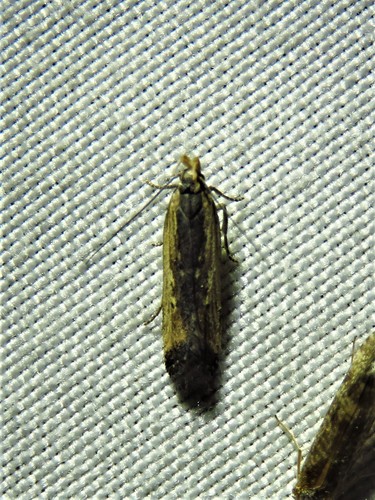
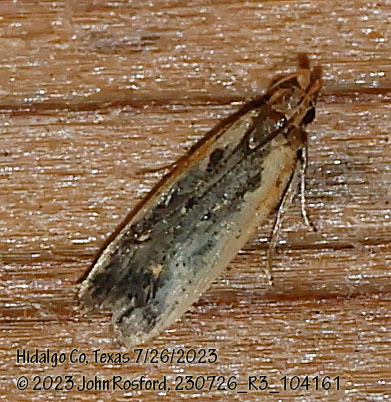
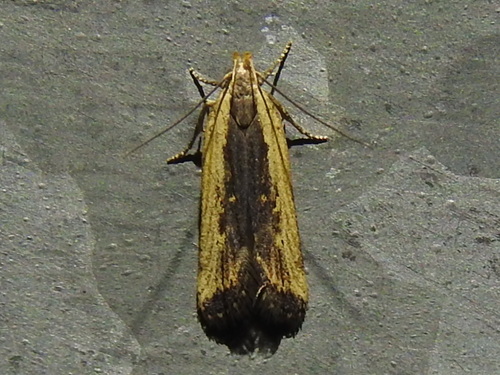
The moth has a wingspan of about 18 mm and its forewings are split lengthwise into a light ocherous costal half and a darker fuscous dorsal half, with a sharp straight dividing line and a tiny light ochreous dot near the cell end.
Source: Wikipedia
How to recognize it
The forewings are divided into two nearly equal longitudinal parts: the costal side is light ocherous and the larger dorsal side is dark fuscous. A very light ochreous round dot appears at the end of the cell.
Source: Wikipedia
Size
The wingspan measures about 18 mm.
Source: Wikipedia
Where it lives
It is also found in northern Mexico.
Source: Wikipedia
When you see it
The flight period covers April-June and August-November.
Source: Wikipedia
Where it comes from
The species occurs in North America, ranging from southern Alberta down to Texas and across the western states mentioned. Its range extends into northern Mexico.
Source: Wikipedia
Where it is found in the US
Recorded in 9 of 51 states and DC. Most records: Texas, Colorado, Arizona, Montana, New Mexico, Idaho, Oklahoma, Washington.
Darker = more records. Counts are museum and citizen-science records, not population size.
Source: GBIF
Status: native in North America; native in Canada. Source: iNaturalist
Months it is reported in the US
Source: GBIF
More photos
Questions people ask
What does Dichomeris simpliciella look like?
Its forewings are split lengthwise into a light ocherous front half and a dark fuscous rear half, separated by a sharp straight line, and it has a tiny light ochreous dot near the cell end.
Source: Wikipedia
Same family (Gelechiidae)
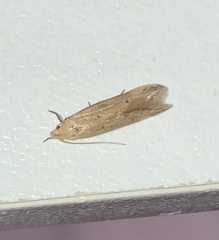 Angoumois Grain MothSitotroga cerealellaDamages trees, gardens or crops
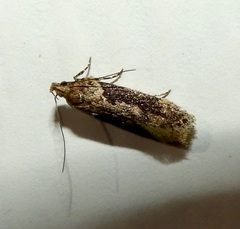 Boxelder Leafworm MothChionodes obscurusella
 Hairy, Toothed, and Shining Dichomeris Moths and AlliesDichomeris setosella
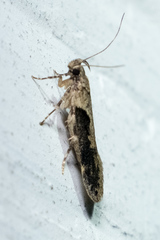 Black-smudged Chionodes Moth and AlliesChionodes occidentellaBlack-smudged Chionodes MothChionodes mediofuscella
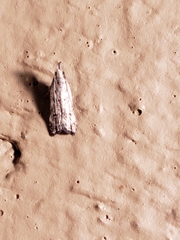 Inverse and Kimball's Dichomeris MothsDichomeris inversella
Sources
- Wikipedia: https://en.wikipedia.org/wiki/Dichomeris_simpliciella
Look it up elsewhere: GBIF · iNaturalist · BugGuide · Wikipedia
Text written 2026-10-29 from the sources above and checked sentence by sentence against them. Data fetched 2026-10-29.