 Bug FAQ
Diabrotica speciosa
Diabrotica speciosa · Order: Coleoptera · Family: Chrysomelidae
Source: Wikipedia

The beetle is native to many South American countries and is a major pest in southern South America. Larvae feed on the roots of crops like maize, wheat, soybean and potatoes, while adults eat a wide range of vegetables, especially cucurbits, beans, grapes and potatoes. Control relies on insecticides applied to soil for larvae and to foliage for adults, often within integrated pest-management programs that include crop rotation and no-till practices.
Source: Wikipedia
Is it a pest in the house?
They can spread plant viruses, which may affect human and animal health if infected crops are consumed.
Source: Wikipedia
How to get rid of it
Insecticides are applied to soil to target larvae and to foliage to target adults, depending on the crop. In southern Brazil, IPM combines no-till farming, soybean-maize or wheat rotation, and insecticide use only when damage is evident.
Source: Wikipedia
What it eats
Adults are highly polyphagous, recorded on over 60 plant species, especially cucurbits. They also feed on beans, grapes and potatoes.
Source: Wikipedia
Lookalikes
It is also called the cucurbit beetle or "vaquita de San Antonio" in Spanish.
Source: Wikipedia
Questions people ask
What crops does Diabrotica speciosa damage?
It harms maize, wheat, soybean, potatoes, cucurbits, beans and grapes.
Source: Wikipedia
How can I control Diabrotica speciosa?
Use soil insecticides for larvae and foliar sprays for adults, often within crop-rotation and no-till IPM programs.
Source: Wikipedia
Where is Diabrotica speciosa originally from?
It is native to many South American countries including Argentina, Brazil and Peru.
Source: Wikipedia
Does Diabrotica speciosa spread disease to people or animals?
It can transmit plant viruses that may affect humans or animals if infected crops are eaten.
Source: Wikipedia
Same family (Chrysomelidae)
 Spotted Cucumber BeetleDiabrotica undecimpunctataDamages trees, gardens or crops
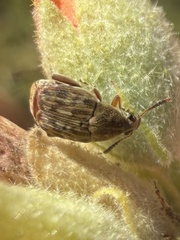 Bean WeevilAcanthoscelides obtectusDamages trees, gardens or crops
 Cowpea WeevilCallosobruchus maculatusDamages trees, gardens or crops
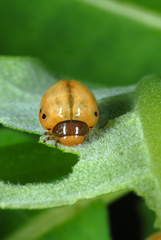 Swamp Milkweed Leaf BeetleLabidomera clivicollisDamages trees, gardens or crops
 Alder Leaf BeetleAgelastica alniDamages trees, gardens or crops
 Dogbane Leaf BeetleChrysochus auratus
Sources
- Wikipedia: https://en.wikipedia.org/wiki/Diabrotica_speciosa
Look it up elsewhere: GBIF · iNaturalist · BugGuide · Wikipedia
Text written 2026-10-22 from the sources above and checked sentence by sentence against them. Data fetched 2026-10-22.