 Bug FAQ
Daffodil Leaf-beetle
Exosoma lusitanicum · Order: Coleoptera · Family: Chrysomelidae
Source: Wikipedia


The beetle is 6 to 8 mm long and has an elongated, smooth oval body. Its back is shiny red-orange while the head, antennae, legs and abdomen are black. Adults feed on wild flowers, especially those in the aster family, and may harm vineyard crops.
Source: Wikipedia
How to recognize it
The beetle’s body is elongated, oval and smooth. The pronotum and wing covers are glossy red-orange; the head, antennae, legs and abdomen are black.
Source: Wikipedia
Size
It grows to about 6 to 8 mm in length.
Source: Wikipedia
Where it lives
It lives in warm, dry places from low plains up to about a thousand metres elevation.
Source: Wikipedia
What it eats
Larvae eat bulbs of Amaryllidaceae and Liliaceae plants. Adults browse flowers of many wild plants, mainly aster family species, and can be a problem for vineyards.
Source: Wikipedia
Life cycle
The young develop inside bulbs of Amaryllidaceae and Liliaceae, while adults feed on wild flowers.
Source: Wikipedia
Where it comes from
It is common in France, Italy, Spain, Portugal, North Africa and the Near East.
Source: Wikipedia
Lookalikes
It resembles the beetle Exososoma theryi.
Source: Wikipedia
More photos


Questions people ask
What does this beetle look like?
It has an elongated, smooth oval body that is shiny red-orange on the back with black head, antennae, legs and abdomen.
Source: Wikipedia
Where is this beetle found?
It occurs in France, Italy, Spain, Portugal, North Africa and the Near East, preferring warm-dry habitats up to a thousand metres.
Source: Wikipedia
Does it damage crops?
Adults feed on wild flowers and can harm vineyards, while larvae eat bulbs of certain ornamental plants.
Source: Wikipedia
Same family (Chrysomelidae)
 Spotted Cucumber BeetleDiabrotica undecimpunctataDamages trees, gardens or crops
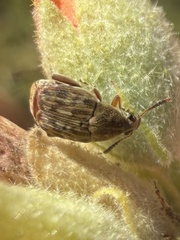 Bean WeevilAcanthoscelides obtectusDamages trees, gardens or crops
 Cowpea WeevilCallosobruchus maculatusDamages trees, gardens or crops
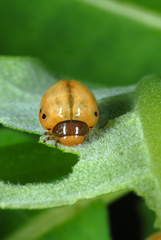 Swamp Milkweed Leaf BeetleLabidomera clivicollisDamages trees, gardens or crops
 Alder Leaf BeetleAgelastica alniDamages trees, gardens or crops
 Dogbane Leaf BeetleChrysochus auratus
Sources
- Wikipedia: https://en.wikipedia.org/wiki/Exosoma_lusitanicum
Look it up elsewhere: GBIF · iNaturalist · BugGuide · Wikipedia
Text written 2026-10-23 from the sources above and checked sentence by sentence against them. Data fetched 2026-10-22.