 Bug FAQ
Confusing Furrow Bee
Halictus confusus · Order: Hymenoptera · Family: Halictidae
Also called: Southern Bronze Furrow Bee, confusing metallic furrow bee, Confused Sweat Bee
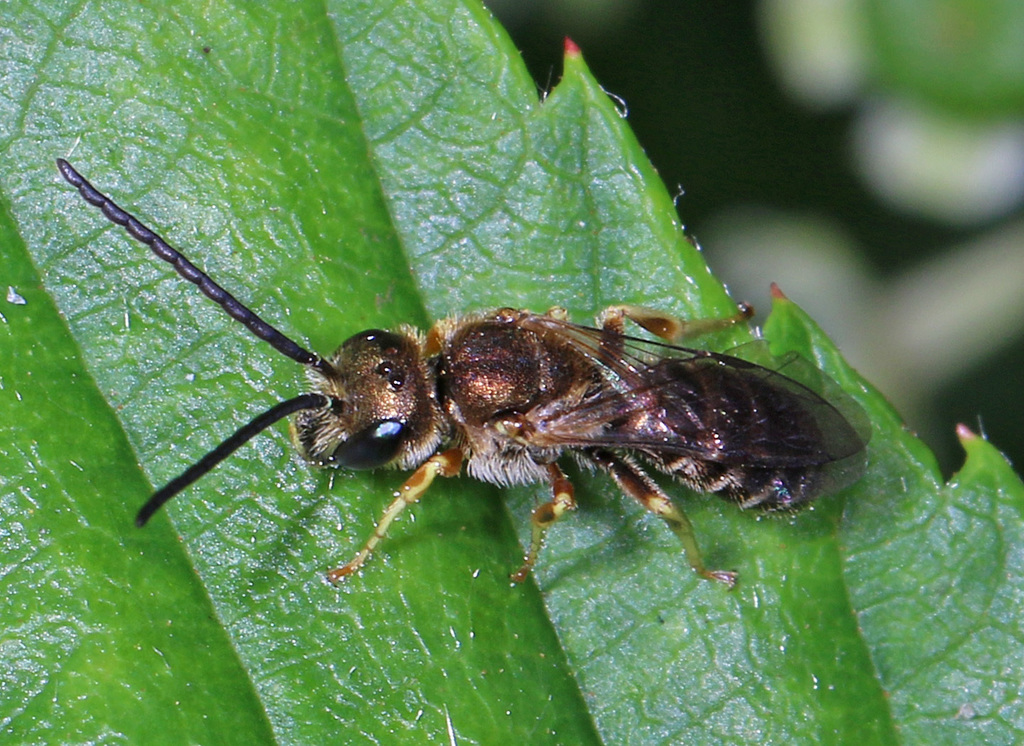
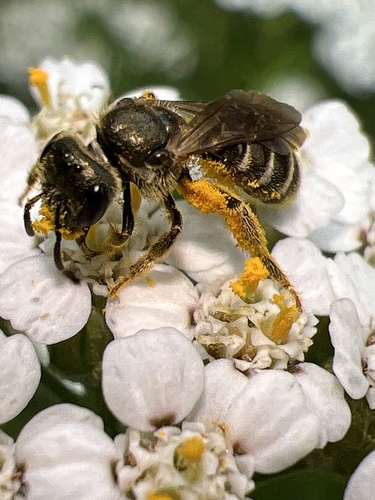
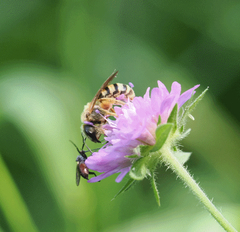
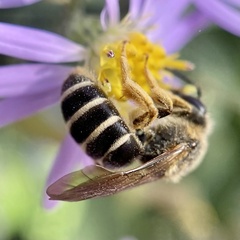
The Confusing Furrow Bee is about 7 mm long, with forewings around 5.5 mm. It lives in open, often sandy habitats across Europe, Asia and North America and visits many kinds of flowers throughout the season. Females have a greenish head and thorax with darker abdomen, while males show yellow markings on the face and legs and a reddish wing vein pattern.
Source: Wikipedia
How to recognize it
Females show a greenish head and thorax that darken to black on the clypeus and abdomen, with metallic green highlights.
Source: Wikipedia
Size
Adults measure about 7 mm (0.28 in) in total length; the forewing is roughly 5.5 mm (0.22 in) long.
Source: Wikipedia
Where it lives
In Britain it prefers sandy heaths and sand pits, while elsewhere it can be found in a wider range of open habitats.
Source: Wikipedia
What it eats
The species is polylectic, gathering pollen from many flower types during the season. Newly emerged queens in North America favor spring beauty (Claytonia virginica) and also use toothwort (Cardamine concatenata).
Source: Wikipedia
Life cycle
Queens start new nests each spring, creating a horizontal entrance tunnel under a mound that the bees guard. Nests are built in aggregations and show primitive eusociality with behaviorally distinct castes but no morphological differences.
Source: Wikipedia
When you see it
When early woodland flowers fade in April, the bees switch to feeding mainly on dandelions. Later, when wintercress (Barbarea vulgaris) blooms abundantly, it becomes the primary pollen source for provisioning nests.
Source: Wikipedia
Where it comes from
It is a primitively eusocial bee native to open areas throughout Europe, Asia and North America.
Source: Wikipedia
Lookalikes
In Europe it can be confused with Halictus tumulorum; reliable separation requires examining male genitalia.
Source: Wikipedia
Where it is found in the US
Recorded in 47 of 51 states and DC. Most records: Maryland, South Dakota, New York, Colorado, Michigan, Vermont, Pennsylvania, Connecticut.
Darker = more records. Counts are museum and citizen-science records, not population size.
Source: GBIF
Status: native in North America; native in United States; native in Canada. Source: iNaturalist
Months it is reported in the US
Source: GBIF
More photos
Questions people ask
How can I tell this bee apart from similar species?
Check the male genitalia for a definitive ID, or look for the wider pale bands on female abdominal segments 3-4 and extra yellow on male leg joints.
Source: Wikipedia
What flowers does the Confusing Furrow Bee visit?
It gathers pollen from many flower types, especially spring beauty and toothwort in early spring, then shifts to dandelions and later wintercress as those bloom.
Source: Wikipedia
Where is this bee found?
It lives in open habitats across Europe, Asia and North America, often favoring sandy areas such as heaths and sand pits in Britain.
Source: Wikipedia
Same family (Halictidae)

Sources
- Wikipedia: https://en.wikipedia.org/wiki/Halictus_confusus
Look it up elsewhere: GBIF · iNaturalist · BugGuide · ITIS · Wikipedia
Text written 2026-10-22 from the sources above and checked sentence by sentence against them. Data fetched 2026-10-22.