 Bug FAQ
Common Snipe Fly
Rhagio mystaceus · Order: Diptera · Family: Rhagionidae

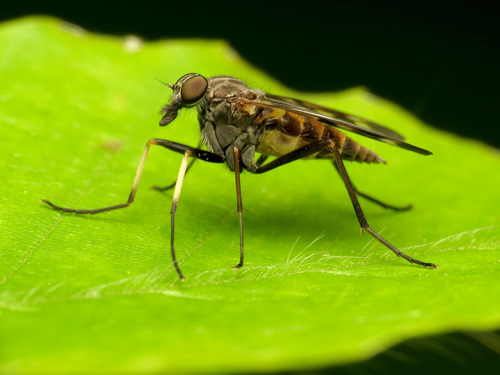
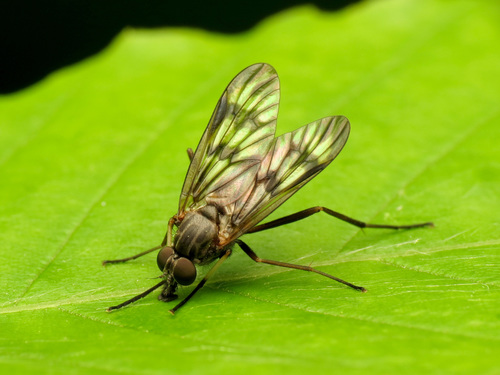
The common snipe fly measures about 6 to 9 mm, with males slightly larger than females. It has three dark stripes on the thorax, a thin pale line in the middle stripe, and yellowish rings on the abdomen, sometimes with a mostly yellow basal segment and a black spot. Its wings have dark tips, and it lives east of the Great Plains in middle and eastern North America.
Source: Wikipedia
How to recognize it
Three dark dorsal stripes run along the thorax, the middle one showing a thin pale line, and the abdomen bears yellowish rings with occasional yellow basal segment and a black spot. The wings are patterned with dark tips.
Source: Wikipedia
Size
Males grow to 7 to 9 mm and females to 6 to 8 mm in length.
Source: Wikipedia
Lookalikes
It is also called the down-looker fly, downlooker snipefly, or common snipe fly and belongs to the family Rhagionidae.
Source: Wikipedia
Where it is found in the US
Recorded in 33 of 51 states and DC. Most records: Massachusetts, New York, Michigan, Pennsylvania, Maryland, Maine, Virginia, Vermont.
Darker = more records. Counts are museum and citizen-science records, not population size.
Source: GBIF
Months it is reported in the US
Source: GBIF
More photos
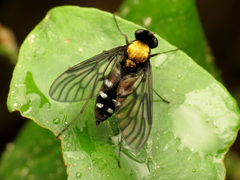
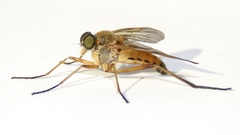
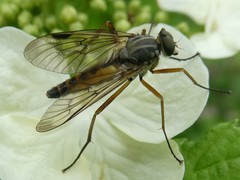
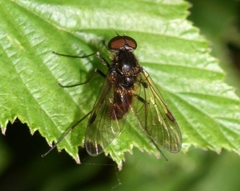
Same family (Rhagionidae)

Sources
- Wikipedia: https://en.wikipedia.org/wiki/Rhagio_mystaceus
Look it up elsewhere: GBIF · iNaturalist · BugGuide · ITIS · Wikipedia
Text written 2026-10-22 from the sources above and checked sentence by sentence against them. Data fetched 2026-10-22.