 Bug FAQ
Common Mountain Grasshopper
Podisma pedestris · Order: Orthoptera · Family: Acrididae

Adult males are 17 to 25 mm long and females 24 to 30 mm, with dark-brown to yellow bodies marked by black and yellow transverse stripes on the abdomen. They live in dry meadows, rocky mountain slopes, alpine pastures and forest clearings from mid-June through October across most of Europe and the eastern Palearctic region.
Source: Wikipedia
How to recognize it
A dark stripe runs from the eye to the pronotum, hind-leg femora are reddish, tibiae bluish with white spines.
Source: Wikipedia
Size
Males reach 17 to 25 mm and females 24 to 30 mm in length.
Source: Wikipedia
Where it lives
Found in dry meadows, rocky mountain slopes, alpine pastures and forest clearings.
Source: Wikipedia
What it eats
Feeds on grasses and other herbaceous plants.
Source: Wikipedia
Life cycle
Females lay their eggs on the ground.
Source: Wikipedia
When you see it
Adults are active from mid-June through October.
Source: Wikipedia
Where it comes from
Native to most of Europe and the eastern Palearctic, extending into temperate mainland East Asia.
Source: Wikipedia
Lookalikes
Both sexes have very short, oval vestigial wings that cannot be used for flight, though some individuals may develop longer wings.
Source: Wikipedia
More photos


Same family (Acrididae)
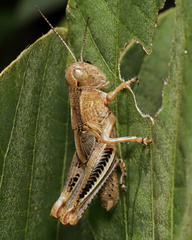 Differential GrasshopperMelanoplus differentialisDamages trees, gardens or crops
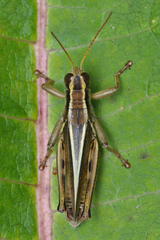 Two-striped GrasshopperMelanoplus bivittatusDamages trees, gardens or crops
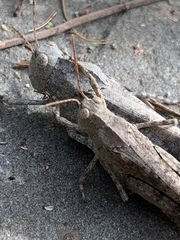 Carolina GrasshopperDissosteira carolinaDamages trees, gardens or crops
 Common Field GrasshopperChorthippus brunneus
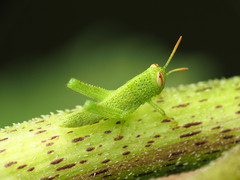 Egyptian Bird GrasshopperAnacridium aegyptium
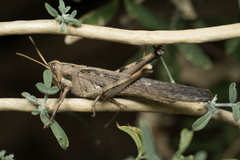 Gray Bird GrasshopperSchistocerca nitensDamages trees, gardens or crops
Sources
- Wikipedia: https://en.wikipedia.org/wiki/Podisma_pedestris
Look it up elsewhere: GBIF · iNaturalist · BugGuide · Wikipedia
Text written 2026-10-23 from the sources above and checked sentence by sentence against them. Data fetched 2026-10-22.