 Bug FAQ
Common Green Grasshopper
Omocestus viridulus · Order: Orthoptera · Family: Acrididae

Adults are 17 to 20 mm long and are usually entirely green, though some may show brown on the sides. They live in moderately wet areas with longer grass and are active from April to October.
Source: Wikipedia
How to recognize it
Males lack red on the abdomen and have a long ovipositor, which helps tell them apart from similar species.
Source: Wikipedia
Size
Body length ranges from 17 to 20 mm (about 0.7 in).
Source: Wikipedia
Where it lives
They prefer habitats with longer grass in moderately wet regions of Europe, including Britain.
Source: Wikipedia
What it eats
They eat common grasses such as Dactylis, Agrostis, Anthoxanthum, Lolium and Holcus.
Source: Wikipedia
Life cycle
Females lay eggs in the topsoil or near grass roots, and there is one generation each year.
Source: Wikipedia
When you see it
Adults are typically seen from April through October.
Source: Wikipedia
Where it comes from
Their range covers most of Europe, extending east to Siberia and Mongolia.
Source: Wikipedia
Lookalikes
Key differences from O. rufipes and O. haemorrhoidalis are the lack of red abdomen and the long ovipositor in males.
Source: Wikipedia
More photos

Questions people ask
Are they a garden pest?
They feed on common grasses and are not reported to damage garden plants.
Source: Wikipedia
Same family (Acrididae)
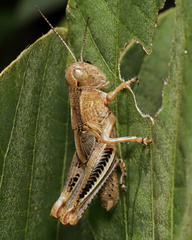 Differential GrasshopperMelanoplus differentialisDamages trees, gardens or crops
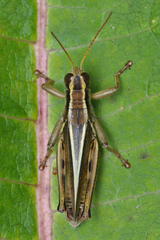 Two-striped GrasshopperMelanoplus bivittatusDamages trees, gardens or crops
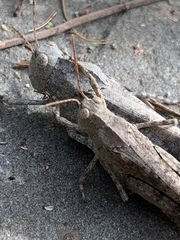 Carolina GrasshopperDissosteira carolinaDamages trees, gardens or crops
 Common Field GrasshopperChorthippus brunneus
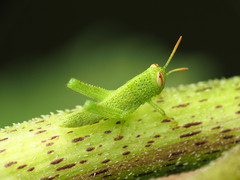 Egyptian Bird GrasshopperAnacridium aegyptium
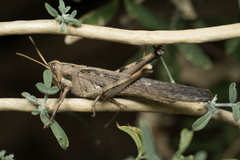 Gray Bird GrasshopperSchistocerca nitensDamages trees, gardens or crops
Sources
- Wikipedia: https://en.wikipedia.org/wiki/Omocestus_viridulus
Look it up elsewhere: GBIF · iNaturalist · BugGuide · Wikipedia
Text written 2026-10-22 from the sources above and checked sentence by sentence against them. Data fetched 2026-10-22.