 Bug FAQ
Cobalt Milkweed Beetle
Chrysochus cobaltinus · Order: Coleoptera · Family: Chrysomelidae
Source: Wikipedia

The cobalt milkweed beetle is a small, 6 to 9 mm beetle with a shiny blue shell. Adults appear in early summer, lay eggs on milkweed and dogbane, and the larvae eat leaf tissue between veins. When many gather, they eat large patches of leaf tissue, causing noticeable damage to those plants.
Source: Wikipedia
How to recognize it
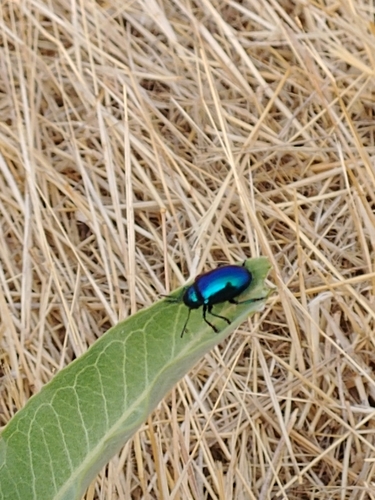
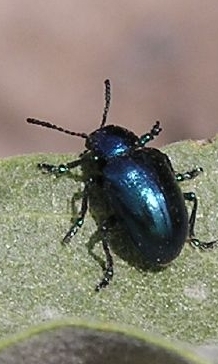
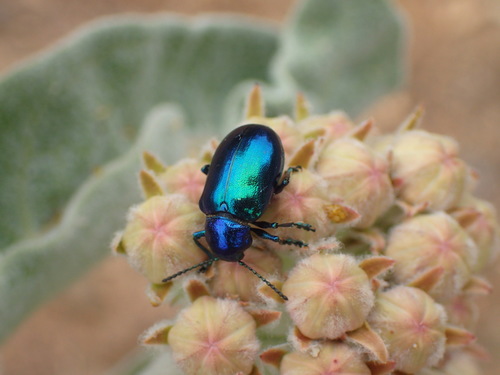
Its exoskeleton shines cobalt-blue and the body is oval, not strongly rounded underneath.
Source: Wikipedia
Size
Both males and females measure about 6 to 9 mm long and have clubbed antennae.
Source: Wikipedia
Is it a pest in the house?
When many are present they eat large portions of leaf tissue, making noticeable holes in the host plants.
Source: Wikipedia
What it eats
Both adults and larvae feed on dogbane and milkweed species. Unlike its close relative, it has a broader diet that includes several milkweed and dogbane plants.
Source: Wikipedia
Life cycle
Females lay eggs on the leaves; the larvae eat the leaf tissue between veins, leaving only a skeleton.
Source: Wikipedia
When you see it
Adults appear in early summer and during spring they disperse in large numbers across local plants.
Source: Wikipedia
Where it comes from
The species is native to the western United States and British Columbia. Historically the two Chrysochus species occupied separate regions.
Source: Wikipedia
Lookalikes
A close relative, C. auratus, looks similar but feeds on a narrower range of plants.
Source: Wikipedia
Where it is found in the US
Recorded in 10 of 51 states and DC. Most records: California, Idaho, Utah, Washington, Oregon, Nevada, Montana, New Mexico.
Darker = more records. Counts are museum and citizen-science records, not population size.
Source: GBIF
Status: native in North America; native in United States; native in Canada. Source: iNaturalist
Months it is reported in the US
Source: GBIF
More photos

Questions people ask
What plants do cobalt milkweed beetles eat?
Both the adults and larvae feed on dogbane and milkweed species.
Source: Wikipedia
When do these beetles show up?
Adults emerge in early summer and can be seen dispersing in large numbers during the spring.
Source: Wikipedia
How do they damage plants?
They chew holes in the leaves, removing leaf tissue and leaving a skeletonized appearance.
Source: Wikipedia
Same family (Chrysomelidae)
 Spotted Cucumber BeetleDiabrotica undecimpunctataDamages trees, gardens or crops
 Bean WeevilAcanthoscelides obtectusDamages trees, gardens or crops
 Cowpea WeevilCallosobruchus maculatusDamages trees, gardens or crops
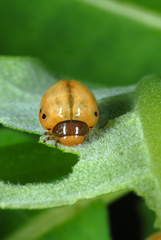 Swamp Milkweed Leaf BeetleLabidomera clivicollisDamages trees, gardens or crops
 Alder Leaf BeetleAgelastica alniDamages trees, gardens or crops
 Dogbane Leaf BeetleChrysochus auratus
Sources
- Wikipedia: https://en.wikipedia.org/wiki/Chrysochus_cobaltinus
Look it up elsewhere: GBIF · iNaturalist · BugGuide · ITIS · Wikipedia
Text written 2026-10-23 from the sources above and checked sentence by sentence against them. Data fetched 2026-10-23.