 Bug FAQ
Club-horned Grasshopper
Aeropedellus clavatus · Order: Orthoptera · Family: Acrididae
Also called: Clubhorned Grasshopper
Source: Wikipedia
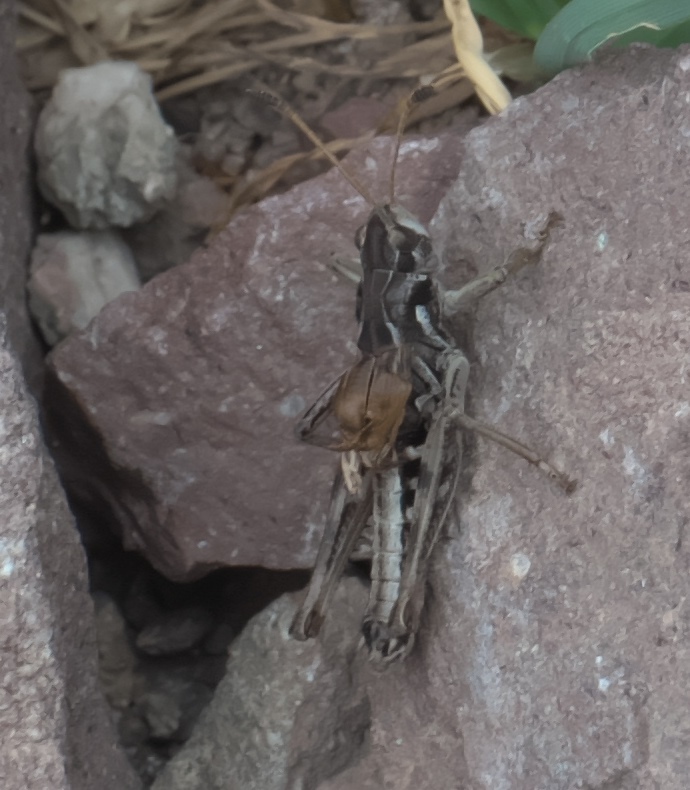
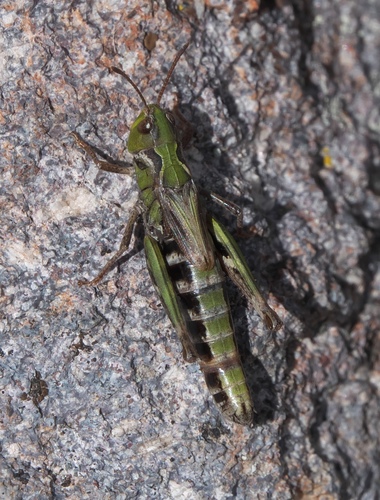
Adult club-horned grasshoppers are 16 to 18 mm long and show light brown, grey or green bodies with black or silver markings. They are named for their club-shaped antennae, where the last six segments are noticeably larger and darker. They live across the Canadian prairies and much of North America, from western Canada down to the southwestern United States, preferring grassland habitats.
Source: Wikipedia
Size
Males measure about 16 to 18 mm (0.63 to 0.71 in) in length.
Source: Wikipedia
Is it a pest in the house?
The grasshopper is not usually an important economic pest, but dense populations can appear under favorable conditions. When numbers are high they can heavily damage forage grasses and cereal grain crops.
Source: Wikipedia
Where it lives
It is the most common grasshopper in the Canadian prairie grasslands.
Source: Wikipedia
What it eats
It mainly eats grasses and sedges, especially Kentucky bluegrass when that grass is present.
Source: Wikipedia
Life cycle
Females lay pods of five to eight eggs in the soil near grass or sedge roots. In plains areas there is one generation each year, while in alpine zones eggs may stay dormant for two or three winters before hatching.
Source: Wikipedia
When you see it
Eggs hatch in very early spring, usually within three to four weeks.
Source: Wikipedia
Lookalikes
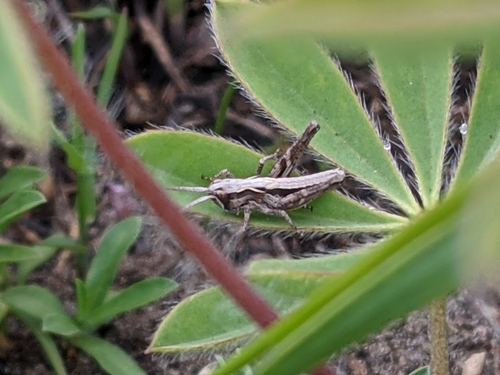
All growth stages have a sharply slanted face, a narrow light stripe above a dark stripe from behind the eye to the abdomen, an hour-glass-shaped constriction on the pronotum, and hind femurs that are grey on the middle and pale grey on the lower edge. Male nymphs develop the club-shaped antennae from the second stage onward, while females keep relatively flat antennae.
Source: Wikipedia
Where it is found in the US
Recorded in 15 of 51 states and DC. Most records: Colorado, Montana, New Mexico, Arizona, Wyoming, North Dakota, Utah, South Dakota.
Darker = more records. Counts are museum and citizen-science records, not population size.
Source: GBIF
Status: native in North America; native in Canada. Source: iNaturalist
Months it is reported in the US
Source: GBIF
More photos
Questions people ask
Where is the club-horned grasshopper found?
It lives across the Canadian prairies and throughout North America, from western Canada down to the southwestern United States.
Source: Wikipedia
What does it eat?
It feeds mainly on grasses and sedges, preferring Kentucky bluegrass when that grass is available.
Source: Wikipedia
Same family (Acrididae)
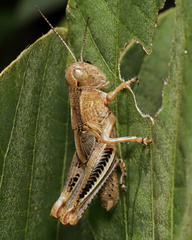 Differential GrasshopperMelanoplus differentialisDamages trees, gardens or crops
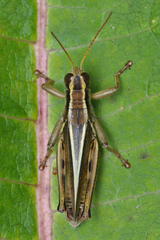 Two-striped GrasshopperMelanoplus bivittatusDamages trees, gardens or crops
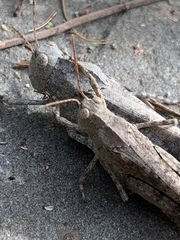 Carolina GrasshopperDissosteira carolinaDamages trees, gardens or crops
 Common Field GrasshopperChorthippus brunneus
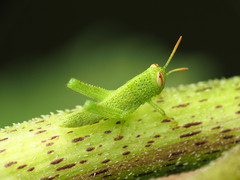 Egyptian Bird GrasshopperAnacridium aegyptium
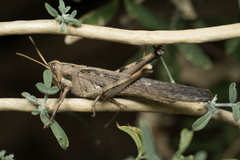 Gray Bird GrasshopperSchistocerca nitensDamages trees, gardens or crops
Sources
- Wikipedia: https://en.wikipedia.org/wiki/Aeropedellus_clavatus
Look it up elsewhere: GBIF · iNaturalist · BugGuide · ITIS · Wikipedia
Text written 2026-10-23 from the sources above and checked sentence by sentence against them. Data fetched 2026-10-23.