 Bug FAQ
Bathroom Moth Fly
Clogmia albipunctatus · Order: Diptera · Family: Psychodidae
Also called: Drain Fly, Filter Fly, White-spotted Moth Fly
Source: Wikipedia
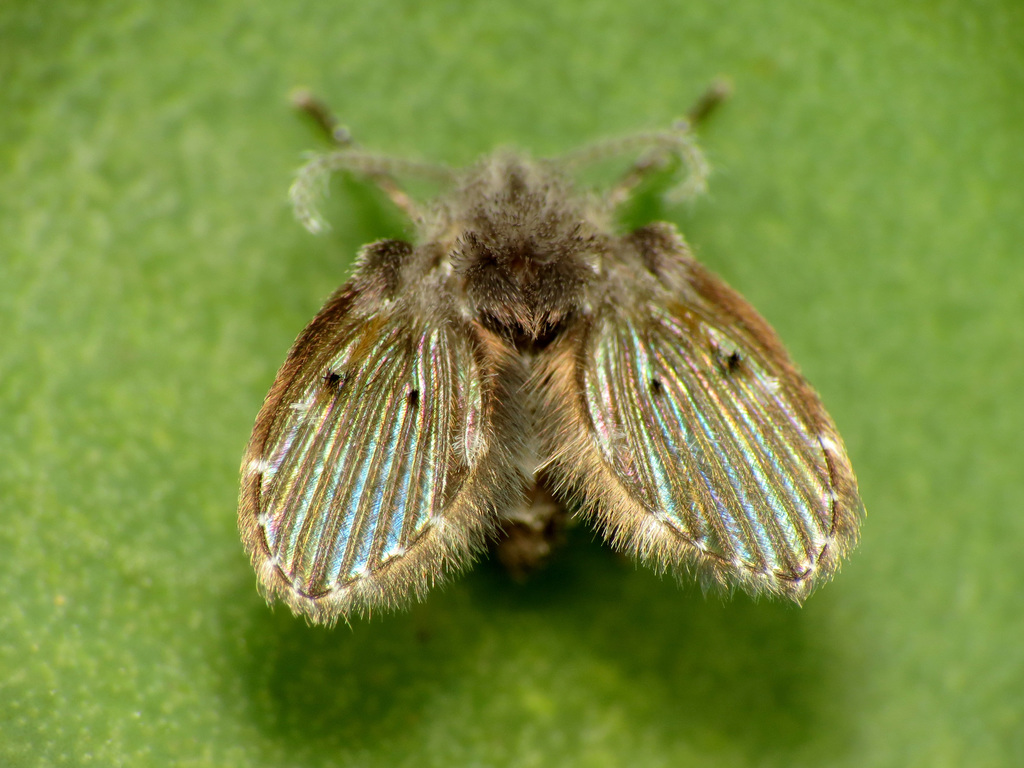
Adults are tiny, about 2.2-2.5 mm long, with broad wings covered in brown-black hairs and distinctive black and white spots near the veins. They live near moist, decaying organic matter such as sewer drains, sewage plants, plant pots, swamps and other shaded wet places, and are found worldwide in tropical and temperate regions, often near humans. Larvae develop in water, feed on decaying matter for about 18 days, then pupate for 5 days before emerging as weak-flying adults that spend most of their time perched on walls.
Source: Wikipedia
How to recognize it
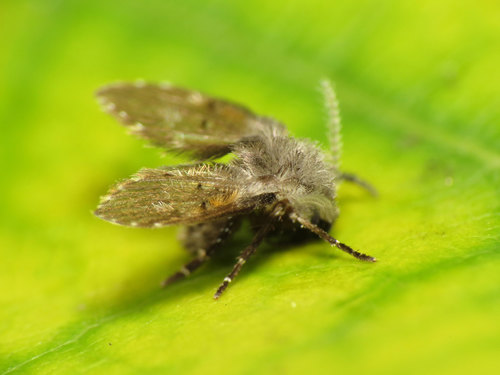
The wings are broad and covered with brownish-black hairs, with a pair of black hair tufts near each vein fork and white hair tufts at the ends of most veins.
Source: Wikipedia
Size
Body length is about 2.2 mm, with some records up to 2.5 mm, and wing length is roughly the same.
Source: Wikipedia
Is it a pest in the house?
They are a common pest around household drains. In commercial buildings, they can breed in moist areas such as sump pump pits, sewers and elevator pits.
Source: Wikipedia
Does it bite or sting?
They are considered harmless, though rare cases of myiasis caused by their larvae have been reported in very poor sanitary conditions.
Source: Wikipedia
How to get rid of it
High-pressure drain cleaning also eradicates the feeding source and cleans the pipe interior, reducing future infestations.
Source: Wikipedia
What it eats
Adults drink water or feed on flower nectar, while larvae live in water and eat decaying organic material.
Source: Wikipedia
Life cycle
Larvae develop in aquatic environments, taking about 18 days to become pupae, which then emerge as adults after roughly 5 days.
Source: Wikipedia
Where it is found in the US
Recorded in 49 of 51 states and DC. Most records: California, Texas, Florida, New York, North Carolina, Pennsylvania, Virginia, Maryland.
Darker = more records. Counts are museum and citizen-science records, not population size.
Source: GBIF
Months it is reported in the US
Source: GBIF
More photos
Questions people ask
How do I get rid of bathroom moth flies?
Clean drains mechanically to remove the organic material the larvae feed on, and consider high-pressure cleaning to clear the entire pipe.
Source: Wikipedia
Do they bite or sting?
They are considered harmless, but in extremely unsanitary conditions their larvae have occasionally caused myiasis.
Source: Wikipedia
Where are they usually found in the house?
They breed in moist places like bathroom drains, sink traps, and other areas with decaying organic matter.
Source: Wikipedia
Same family (Psychodidae)

Sources
- Wikipedia: https://en.wikipedia.org/wiki/Clogmia_albipunctata
Look it up elsewhere: GBIF · iNaturalist · BugGuide · Wikipedia
Text written 2026-10-23 from the sources above and checked sentence by sentence against them. Data fetched 2026-10-23.