 Bug FAQ
Moth fly
Psychoda alternata · Order: Diptera · Family: Psychodidae
Source: UC IPM
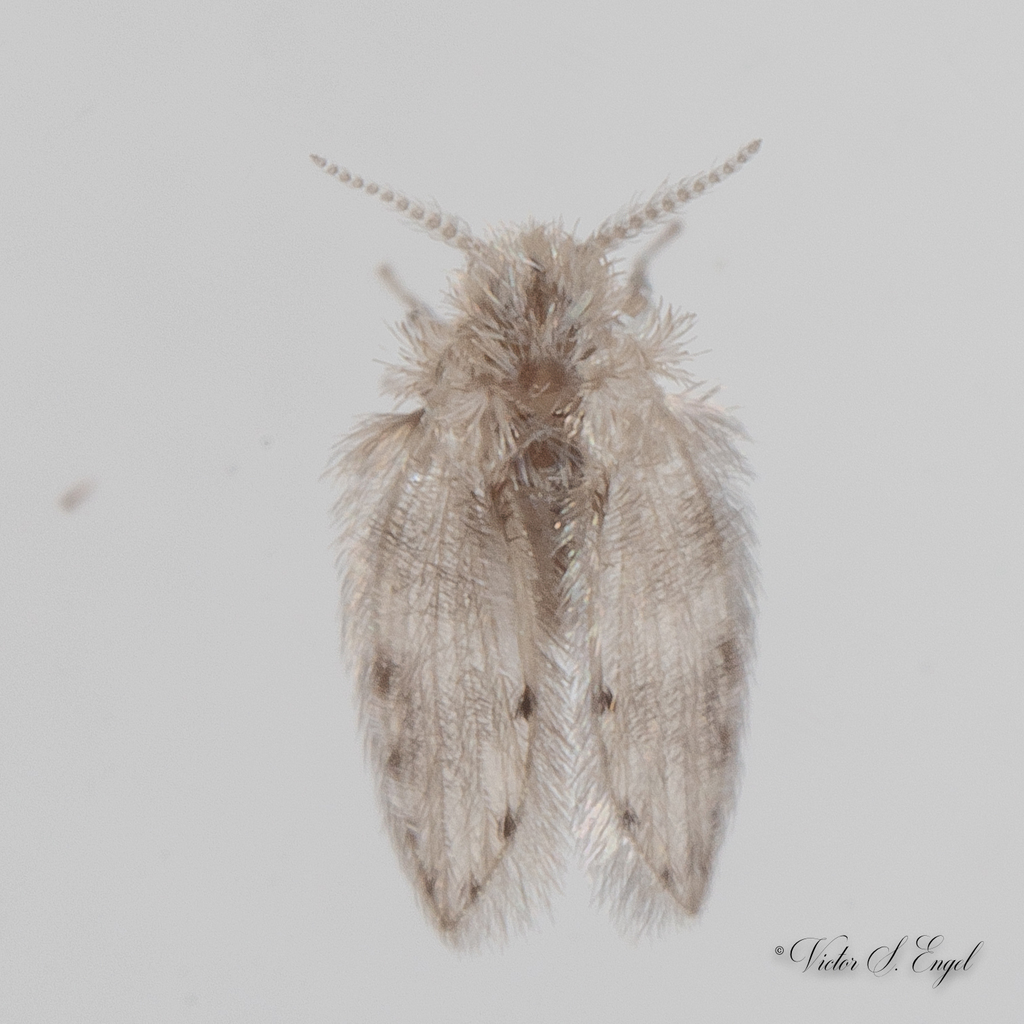
Adult moth flies are about 4 mm long, dark, and rest with their wings held roof-like over the back. The larvae live in moist, organic-rich places such as drains, and the adults stay close to where they hatched. Control means removing the breeding sites; call a professional if they are hidden in walls or foundations.
How to recognize it
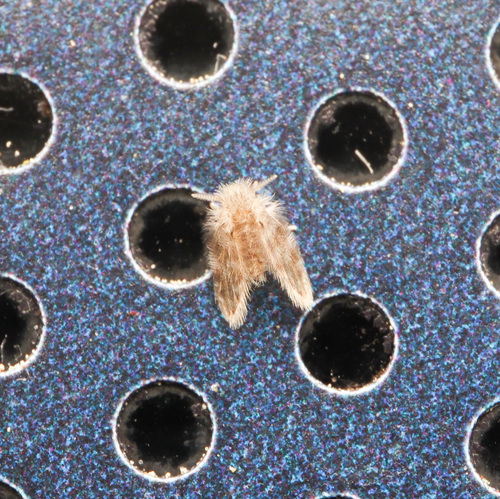
Wings are broad, held at an angle, grey with dense hairlike scales and parallel veins from base to tip. Moth flies are small, about 1/8 inch, dark-colored and rest with wings over their back.
Size
Females are about 4 mm (0.2 in) long; males are slightly smaller.
Source: Wikipedia
Is it a pest in the house?
Moth flies develop in decaying organic matter in sinks and sewer drains. They do not bite, damage structures, or harm plants.
Source: UC IPM
Does it bite or sting?
They never bite people or animals, but may carry pathogens that can cause allergies or disease.
Source: UC IPM
How to get rid of it
Eliminate all moist breeding sites to manage moth flies. If breeding sites are hidden in walls or foundations, contact a professional pest service.
Source: UC IPM
Where it lives
Larvae develop in moist, organic-rich sites like drains, filter systems, ditches and sludge.
Source: Wikipedia
What it eats
Larvae are slender, whitish to pale brown with strong jaws and feed on decaying organic matter.
Source: Wikipedia
Life cycle
Females lay up to 100 eggs in gelatinous batches of 15-40 in moist breeding sites. At 70 °F the larval stage lasts about 15 days and is the stage that overwinters in diapause.
Source: Wikipedia
Where it comes from
Originally from North America, it now occurs worldwide, including Europe, western Asia and South America.
Source: Wikipedia
Lookalikes
Their unbranched, parallel wing veins help separate them from other house flies.
Source: UC IPM
Where it is found in the US
Recorded in 40 of 51 states and DC. Most records: California, Montana, Texas, Illinois, Maryland, Virginia, Michigan, North Carolina.
Darker = more records. Counts are museum and citizen-science records, not population size.
Source: GBIF
Months it is reported in the US
Source: GBIF
More photos
Questions people ask
Can they spread disease?
They can carry pathogens that may cause illness or trigger allergies.
Source: UC IPM
How can I get rid of them?
Remove all moist, organic-rich breeding sites; if they are hidden in walls, call a pest professional.
Source: UC IPM
Same family (Psychodidae)

Sources
- UC IPM: https://ipm.ucanr.edu/PMG/PESTNOTES/pn74167.html
- Wikipedia: https://en.wikipedia.org/wiki/Psychoda_alternata
Look it up elsewhere: GBIF · iNaturalist · BugGuide · ITIS · Wikipedia
Text written 2026-10-22 from the sources above and checked sentence by sentence against them. Data fetched 2026-10-22.