 Bug FAQ
Chestnut Bob
Iambrix salsala · Order: Lepidoptera · Family: Hesperiidae
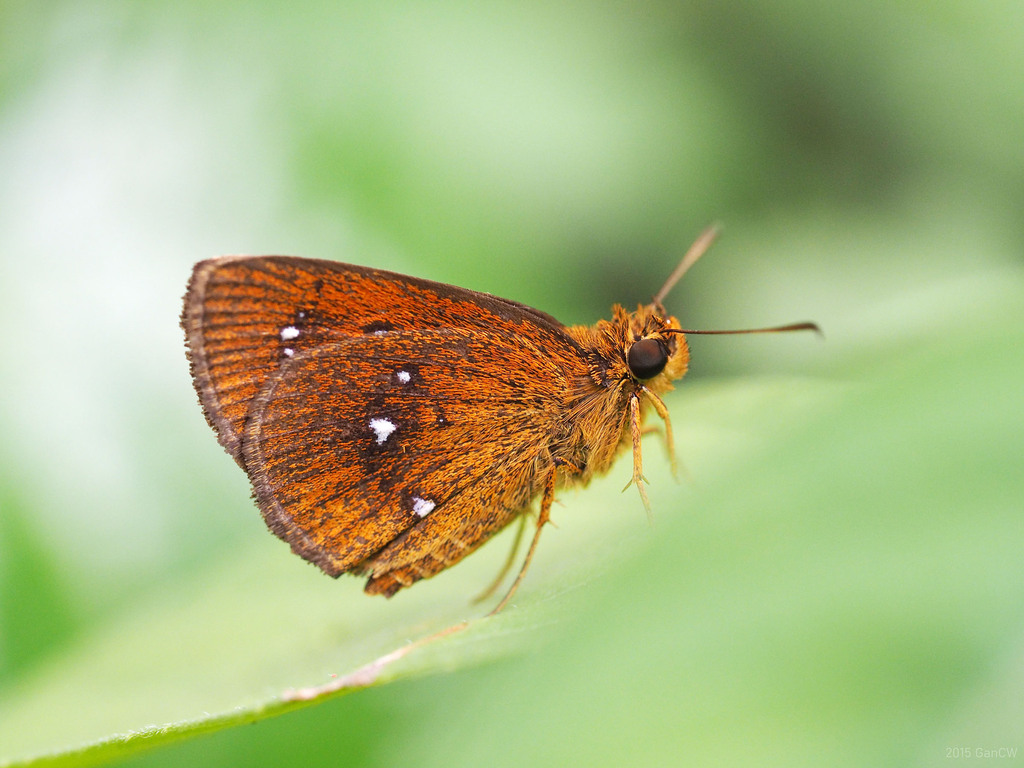
Chestnut Bob butterflies are dark brown with an olive-brown shine and have distinctive yellowish or white spots on the forewings of males and females. They live across South and Southeast Asia, from Sri Lanka and India through Myanmar, Thailand, Cambodia, Laos, Vietnam, southern China, Malaysia, Singapore, Indonesia and nearby islands. The caterpillars feed on grasses such as Setaria barbata, bamboo species and Mimosa plants.
Source: Wikipedia
How to recognize it
Males are dark brown with an olive-brown gloss and show two or three vague yellowish spots on the forewing. Females are similarly colored and have a line of small semi-transparent white spots across the forewing, ending in a faint yellowish spot.
Source: Wikipedia
Where it lives
In India they are found in South India, Calcutta, and along the Himalayas from Kumaon to Sikkim, as well as in Assam and eastward to Myanmar.
Source: Wikipedia
What it eats
Caterpillars have been recorded feeding on Setaria barbata, bamboo species and Mimosa species.
Source: Wikipedia
Life cycle
The larval stage feeds on Setaria barbata, bamboo and Mimosa plants.
Source: Wikipedia
Lookalikes
Some experts consider Chestnut Bob identical to the species A. stellifer, noting variation in forewing spots.
Source: Wikipedia
Questions people ask
Where might I see a Chestnut Bob?
They are found throughout South and Southeast Asia, including India, Sri Lanka, Myanmar, Thailand, Malaysia, Singapore, Indonesia and nearby islands.
Source: Wikipedia
Same family (Hesperiidae)




Sources
- Wikipedia: https://en.wikipedia.org/wiki/Iambrix_salsala
Look it up elsewhere: GBIF · iNaturalist · BugGuide · Wikipedia
Text written 2026-10-22 from the sources above and checked sentence by sentence against them. Data fetched 2026-10-22.