 Bug FAQ
Castor Bean Tick
Ixodes ricinus · Order: Ixodida · Family: Ixodidae
Also called: Common Tick, Common sheep tick, Deer tick, Face tick

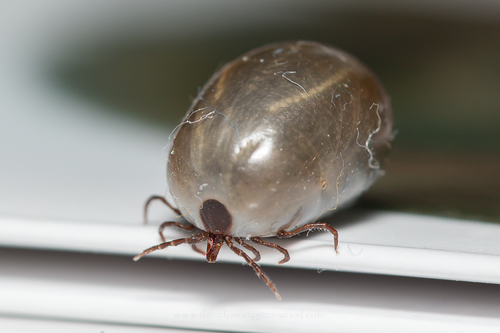
Adult males are about 2.5 mm long, females grow to 3 to 3.6 mm before feeding and can swell to 11 mm when engorged. They live in humid woodlands, heaths and forests across Europe, North Africa and the Middle East, avoiding dry Mediterranean areas. Ticks have no eyes, no festoons, long palpi, and an anal groove positioned above the anus.
Source: Wikipedia
How to recognize it
Like other Ixodes species, they lack eyes and decorative markings and have no festoons on the rear edge.
Source: Wikipedia
Size
Adult males measure 2.4 to 2.8 mm, unfed nymphs 1.3 to 1.5 mm, and females 3.0 to 3.6 mm before feeding. When fully engorged, females can reach about 11 mm in length.
Source: Wikipedia
Does it bite or sting?
While feeding, ticks can transmit pathogens that cause Lyme disease, louping ill, Q fever, tick-borne encephalitis and an alpha-gal allergy. Their saliva contains anesthetic compounds, so the bite is often painless.
How to get rid of it
In the United States, ticks are known to spread germs that make people sick; learning where they live and how to prevent bites is important.
Source: CDC
Where it lives
They are most common where hosts are abundant, such as woodlands, heaths and forests. They prefer relatively humid areas and are absent from dry Mediterranean regions.
Source: Wikipedia
What it eats
Larvae usually feed on insectivores like shrews, but can also bite rodents, rabbits, birds, reptiles or bats.
Source: Wikipedia
Life cycle
The species has a three-host life cycle that typically takes 2 to 3 years, but may range from 1 to 6 years. Nymphs climb on grass or leaves and wait for a passing host, a behavior called questing.
Source: Wikipedia
When you see it
Nymph questing peaks in late spring and early summer, driven by temperature and humidity. Adults feed on large mammals for 6 to 13 days.
Source: Wikipedia
Where it comes from
Their range covers Europe, parts of North Africa, the Middle East, up to Iceland in the north and into Russia in the east.
Source: Wikipedia
Lookalikes
The parasitic wasp Ixodiphagus hookeri may lay eggs inside castor bean ticks, though it uses other hosts as well.
Source: Wikipedia
Where it is found in the US
Recorded in 3 of 51 states and DC. Most records: Alaska, Texas, Virginia.
Darker = more records. Counts are museum and citizen-science records, not population size.
Source: GBIF
Status: introduced in Canada. Source: iNaturalist
More photos
Questions people ask
Do castor bean ticks bite humans?
Yes, adult ticks attach to humans and can feed for up to two weeks, potentially transmitting diseases.
Source: Wikipedia
When are ticks most active?
Nymphs are most active in late spring and early summer, while adults feed whenever they find a suitable host.
Source: Wikipedia
How big do they get?
Unfed adults are about 3 mm long, but after feeding they can swell to roughly 11 mm.
Source: Wikipedia
Where are they found?
They live in humid woodlands and forests across Europe, North Africa and the Middle East, avoiding dry Mediterranean areas.
Source: Wikipedia
Same family (Ixodidae)
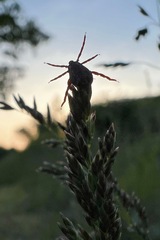 American Dog TickDermacentor variabilisCan spread germs or disease
 Eastern Black-legged TickIxodes scapularisCan spread germs or disease
 Lone Star TickAmblyomma americanumCan spread germs or disease
 Gulf Coast TickAmblyomma maculatumCan spread germs or disease
 Western Black-legged TickIxodes pacificusCan spread germs or disease
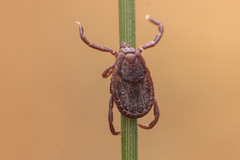 Brown Dog TickRhipicephalus sanguineusCan spread germs or disease
Sources
- Wikipedia: https://en.wikipedia.org/wiki/Ixodes_ricinus
- CDC: https://www.cdc.gov/ticks/about/index.html
Look it up elsewhere: GBIF · iNaturalist · BugGuide · ITIS · Wikipedia
Text written 2026-10-22 from the sources above and checked sentence by sentence against them. Data fetched 2026-10-22.