 Bug FAQ
Carrhotus xanthogramma
Carrhotus xanthogramma · Order: Araneae · Family: Salticidae
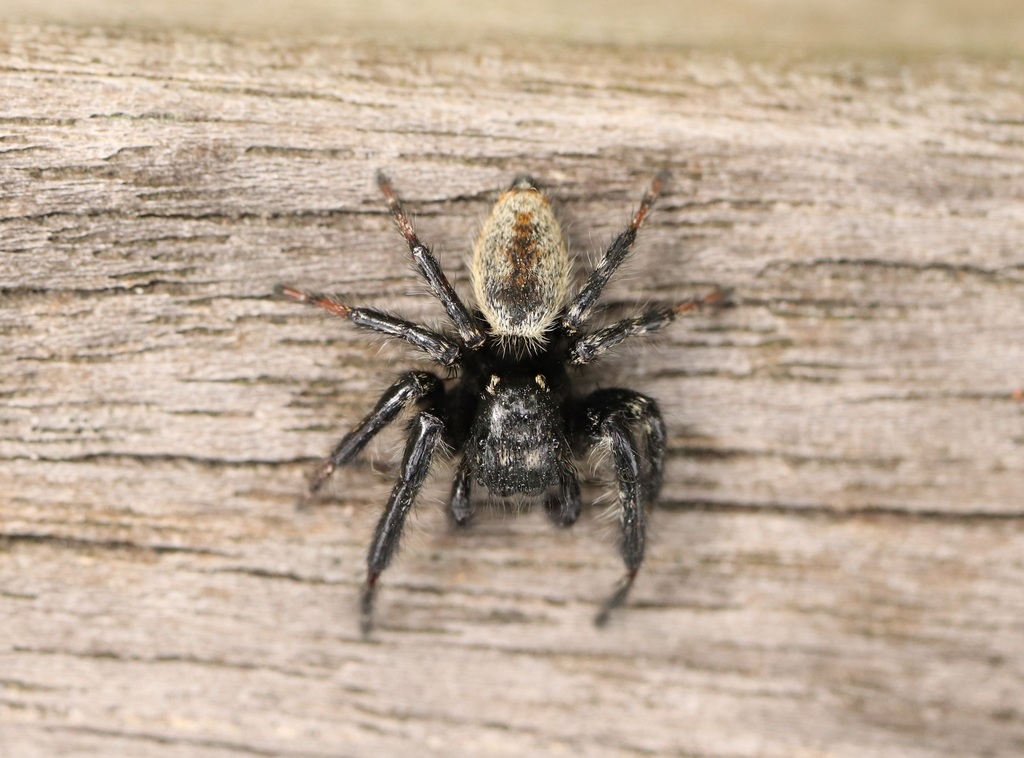
Male Carrhotus xanthogramma are about 5 to 7 mm long, females are larger at 7 to 9 mm. Males have a black, shiny front body and a reddish-orange, flattened abdomen, while females are mostly brown with dark markings and a yellowish band across the front head. These jumping spiders like warm, sunny spots and are found on bushes, tree trunks and shrubbery during spring and summer (April-July).
Source: Wikipedia
How to recognize it
Males show a black, glossy cephalothorax and a reddish-orange, hairy abdomen. Females are mainly brown with dark spots and a yellowish area on a dark front head that forms an arc across the eyes.
Source: Wikipedia
Size
Adult males measure 5.1 to 7.1 mm, females 7.1 to 9.0 mm in body length.
Source: Wikipedia
Where it lives
They prefer warm, sunny environments and are commonly seen on bushes, tree trunks and shrubbery.
Source: Wikipedia
What it eats
They actively hunt and jump on prey, using excellent eyesight to locate it.
Source: Wikipedia
Life cycle
Adults are present from April through July.
Source: Wikipedia
When you see it
You will find them in spring and summer, especially between April and July.
Source: Wikipedia
Where it comes from
Their Palearctic range includes much of Europe, parts of Turkey, the Caucasus, Central and East Asia, and Japan.
Source: Wikipedia
Same family (Salticidae)



Sources
- Wikipedia: https://en.wikipedia.org/wiki/Carrhotus_xanthogramma
Look it up elsewhere: GBIF · iNaturalist · BugGuide · ITIS · Wikipedia
Text written 2026-10-22 from the sources above and checked sentence by sentence against them. Data fetched 2026-10-22.