 Bug FAQ
Brown Armoured Corncricket
Acanthoplus discoidalis · Order: Orthoptera · Family: Tettigoniidae
Also called: Brown Armored Corncricket, Green Armoured Corncricket
Source: Wikipedia


The brown armoured corncricket is a flight-less, wide-bodied insect about 5 cm long, with sharp spines on its pronotum and strong mandibles that can bite. Control is easiest by digging a 50 cm deep trench around fields, optionally adding poisoned bait.
Source: Wikipedia
How to recognize it
The pronotum carries several sharp, cone-shaped spines. Its mandibles are powerful and can give a painful nip.
Source: Wikipedia
Size
Adults are about 5 cm (1.95 in) long and have a broad, wingless body.
Source: Wikipedia
Is it a pest in the house?
In bad years the insects can destroy up to 40 % of sorghum and millet crops.
Source: Wikipedia
Does it bite or sting?
When threatened from the side, both sexes may bite the attacker; males also produce a stridulating sound, while females lack a functional stridulatory organ.
Source: Wikipedia
How to get rid of it
Because it cannot fly, digging a trench about 50 cm deep around the field can keep it out. Poisoned bait placed in the trench can increase control effectiveness. Insecticides are another option for managing infestations.
Source: Wikipedia
Where it lives
It lives in fields where sorghum and millet are grown in southern Africa.
Source: Wikipedia
What it eats
The species is omnivorous, feeding on a wide range of foods, including tough plants, carrion and even nestlings of red-billed quelea.
Source: Wikipedia
Life cycle
Mating begins at sunset and finishes by sunrise; females must mate before laying eggs but can store sperm for later clutches.
Source: Wikipedia
When you see it
In autumn, when protein and salt are scarce, they become cannibalistic and may gather around crushed conspecifics on roads.
Source: Wikipedia
Where it comes from
It is native to Angola, Namibia, Botswana, Zimbabwe and South Africa.
Source: Wikipedia
More photos


Questions people ask
Do they bite people?
Yes, they can bite with their strong mandibles, causing a painful nip.
Source: Wikipedia
What crops do they damage?
They are a pest of sorghum and millet and can cause up to 40 % loss in poor years.
Source: Wikipedia
Same family (Tettigoniidae)
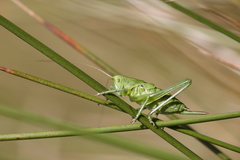 Great Green Bush-cricketTettigonia viridissimaCan bite
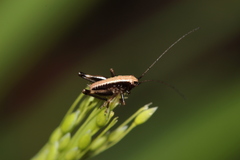 Dark Bush-cricketPholidoptera griseoaptera
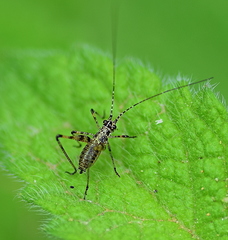 Mediterranean KatydidPhaneroptera nanaDamages trees, gardens or crops
 Fork-tailed Bush KatydidScudderia furcataDamages trees, gardens or crops
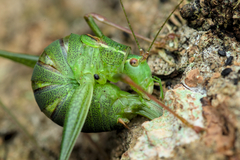 Speckled Bush-cricketLeptophyes punctatissima
 Roesel's Bush-cricketRoeseliana roeselii
Sources
- Wikipedia: https://en.wikipedia.org/wiki/Acanthoplus_discoidalis
Look it up elsewhere: GBIF · iNaturalist · BugGuide · Wikipedia
Text written 2026-10-23 from the sources above and checked sentence by sentence against them. Data fetched 2026-10-23.