 Bug FAQ
Bronze Hopper
Helpis minitabunda · Order: Araneae · Family: Salticidae
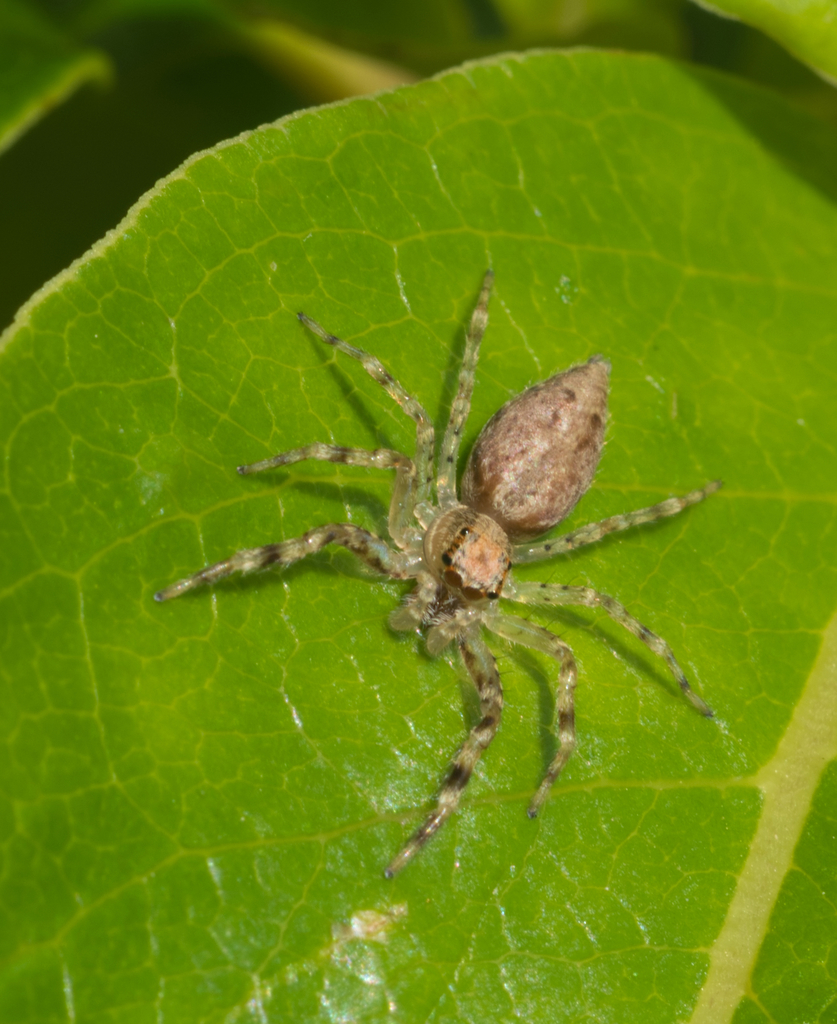
Male Bronze Hoppers can reach about 10 mm, while females grow to about 8 mm, and males are larger than females. Males have longer, darker front legs and a flat, creamy-white-haired head, which help tell them apart from females. These jumping spiders live in moist foliage, especially in eastern and southeastern Australia, and are also found in New Zealand and Papua New Guinea.
Source: Wikipedia
How to recognize it
Males have noticeably longer and darker front legs than females. The male’s head is flat-topped and covered with creamy white hairs.
Source: Wikipedia
Size
Males can grow up to 10 mm long, while mature females reach up to 8 mm. Unlike most spiders, the male is larger than the female.
Source: Wikipedia
Where it lives
They are typically found among foliage in moist areas. They are most commonly observed in eastern and southeastern Australia.
Source: Wikipedia
What it eats
Males are active, aggressive hunters that often prey on smaller spiders. Females tend to be more cryptic in their hunting behavior.
Source: Wikipedia
Life cycle
The species shows sexual dimorphism in both appearance and behavior. Mating involves a courtship dance that lasts two to three hours.
Source: Wikipedia
When you see it
They are regularly observed in eastern and southeastern Australia. In New Zealand they are listed as an invasive species.
Source: Wikipedia
Where it comes from
Within Australia they are especially common in the east and southeast.
Source: Wikipedia
Questions people ask
How can I tell a male Bronze Hopper from a female?
Males have longer, darker front legs and a flat, creamy-white-haired head, while females lack these features.
Source: Wikipedia
Where am I likely to find Bronze Hoppers?
Look for them in moist foliage, especially in eastern and southeastern parts of Australia; they also occur in New Zealand and Papua New Guinea.
Source: Wikipedia
What do Bronze Hoppers eat?
Males actively hunt and often eat smaller spiders; females are more hidden and less aggressive.
Source: Wikipedia
Same family (Salticidae)



Sources
- Wikipedia: https://en.wikipedia.org/wiki/Helpis_minitabunda
Look it up elsewhere: GBIF · iNaturalist · BugGuide · ITIS · Wikipedia
Text written 2026-10-22 from the sources above and checked sentence by sentence against them. Data fetched 2026-10-22.