 Bug FAQ
Bronze Beetle
Chrysolina bankii · Order: Coleoptera · Family: Chrysomelidae
Also called: Leaf beetle

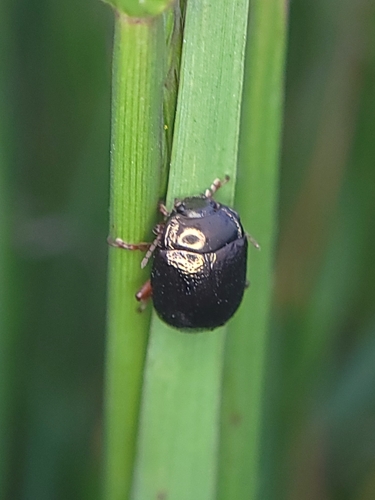
Adult bronze beetles are about 8-10.7 mm long and have a metallic bronze body with orange-brown legs and punctured wing covers. They live in open, sunny places like grasslands, meadows, woodland edges and coastal areas, feeding on leaves of many plants, especially those in the Asteraceae and Lamiaceae families and ribwort plantain. Females lay eggs on the undersides of leaves; in cold climates the larvae overwinter, while adults may be present year-round in warmer spots.
Source: Wikipedia
Size
Adults measure between 8 and 10.7 mm in length.
Source: Wikipedia
Where it lives
They are found in open, sunny habitats such as grasslands, meadows, woodland edges and coastal areas.
Source: Wikipedia
What it eats
They eat a variety of leaves, especially those of plants in the Asteraceae and Lamiaceae families, and they like ribwort plantain.
Source: Wikipedia
Where it is found in the US
Recorded in 3 of 51 states and DC. Most records: California, Virginia, South Carolina.
Darker = more records. Counts are museum and citizen-science records, not population size.
Source: GBIF
Status: introduced in United States. Source: iNaturalist
Months it is reported in the US
Source: GBIF
More photos


Same family (Chrysomelidae)
 Spotted Cucumber BeetleDiabrotica undecimpunctataDamages trees, gardens or crops
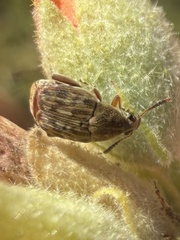 Bean WeevilAcanthoscelides obtectusDamages trees, gardens or crops
 Cowpea WeevilCallosobruchus maculatusDamages trees, gardens or crops
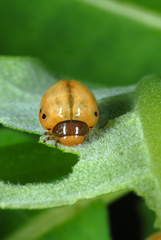 Swamp Milkweed Leaf BeetleLabidomera clivicollisDamages trees, gardens or crops
 Alder Leaf BeetleAgelastica alniDamages trees, gardens or crops
 Dogbane Leaf BeetleChrysochus auratus
Sources
- Wikipedia: https://en.wikipedia.org/wiki/Chrysolina_bankii
Look it up elsewhere: GBIF · iNaturalist · BugGuide · Wikipedia
Text written 2026-10-22 from the sources above and checked sentence by sentence against them. Data fetched 2026-10-22.