 Bug FAQ
Brilliant Jumping Spider
Phidippus clarus · Order: Araneae · Family: Salticidae
Also called: Eastern Red-back Jumping Spider, Brilliant Jumper, Florida Red-backed Jumper

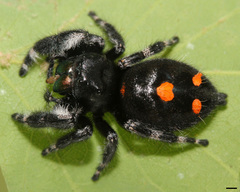
The brilliant jumping spider is a small predator found in old fields across most of the United States, southern Canada, and western Mexico, where it lives among flowers and sometimes shares space with crab spiders. Females are about 4 mm wide and weigh up to 400 mg when ready to lay eggs, while males are slightly smaller at about 3 mm wide; they mature in early summer and females die after a single brood. Their coloration is usually red or brown, but can appear lighter yellow or brown with darker markings, and they feed on insects, other spiders, and various arthropods.
Source: Wikipedia
How to recognize it
They are typically red or brown, sometimes lighter yellow or brown with darker spots.
Source: Wikipedia
Size
Females average about 4 mm wide, males about 3 mm.
Source: Wikipedia
Where it lives
They live among flowers in old fields and may share the area with the crab spider Misumena vatia.
Source: Wikipedia
What it eats
They hunt insects, other spiders, and various terrestrial arthropods.
Source: Wikipedia
Life cycle
Adults appear in early summer; females ready to lay eggs weigh about 400 mg. Females die after one brood leaves the nest, unlike most other Phidippus species.
Source: Wikipedia
When you see it
In early to mid-July, more males are present than females.
Source: Wikipedia
Where it comes from
Their range includes most of the United States, southern Canada, and western Mexico.
Source: Wikipedia
Where it is found in the US
Recorded in 49 of 51 states and DC. Most records: Virginia, North Carolina, Illinois, Georgia, Ohio, Texas, Oklahoma, Maryland.
Darker = more records. Counts are museum and citizen-science records, not population size.
Source: GBIF
Status: native in North America; native in United States; native in Canada. Source: iNaturalist
Months it is reported in the US
Source: GBIF
More photos


Same family (Salticidae)



Sources
- Wikipedia: https://en.wikipedia.org/wiki/Phidippus_clarus
Look it up elsewhere: GBIF · iNaturalist · BugGuide · ITIS · Wikipedia
Text written 2026-10-22 from the sources above and checked sentence by sentence against them. Data fetched 2026-10-22.