 Bug FAQ
Blue-winged Grasshopper
Oedipoda caerulescens · Order: Orthoptera · Family: Acrididae
Also called: Blue Band-winged Grasshopper
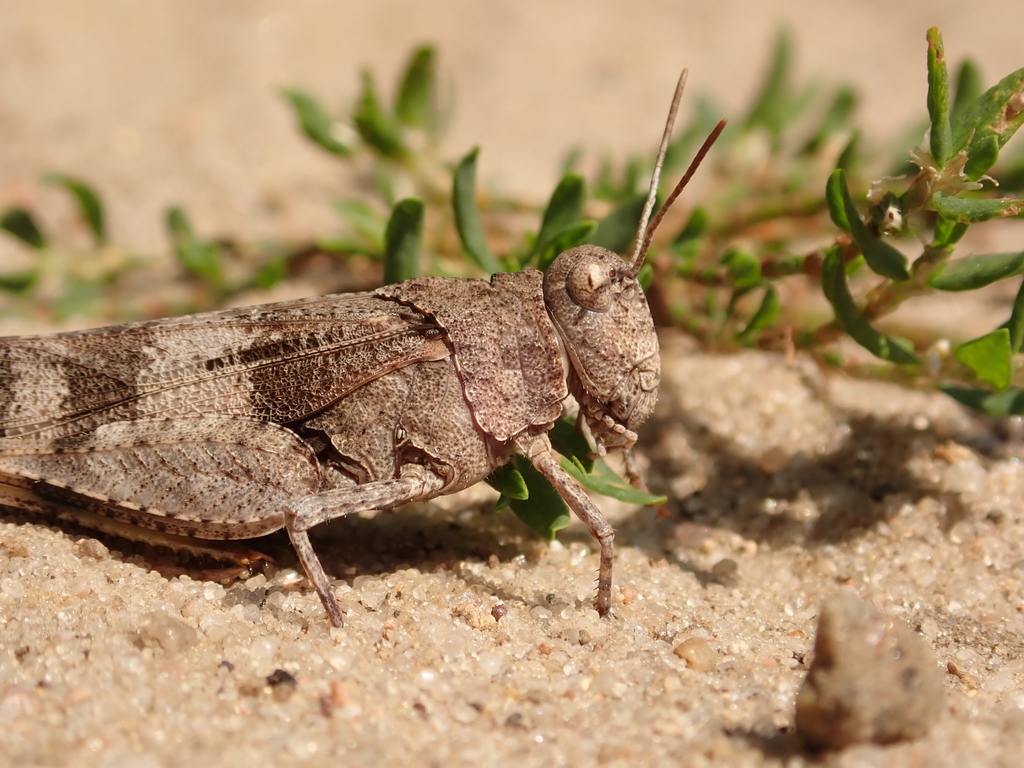
The blue-winged grasshopper is a medium-sized insect, males about 15 to 21 mm and females 22 to 28 mm long. It is most recognizable by bright turquoise hind wings with a black edge and pale bands on the forewings, and the upper side of the hind femur has a notch. It lives in dry, open places such as dunes, heathlands, sandy grasslands and sunny limestone rocks, often on disturbed ground like quarries or railway ballast.
Source: Wikipedia
How to recognize it
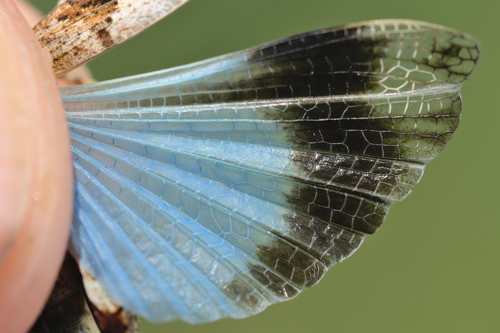
When it flies away the hind wings flash a turquoise colour with a black marginal stripe, and the forewings usually show two or three pale cross-bands. The upper surface of the hind femur has a distinct notch.
Source: Wikipedia
Size
Males measure 15 to 21 mm, females 22 to 28 mm.
Source: Wikipedia
Where it lives
It prefers dry, open habitats with low vegetation such as dunes, heathlands, sandy grasslands and sun-lit limestone rocks. It is also common on recently disturbed sites like coal spoil heaps, quarries, pits and railway ballast.
Source: Wikipedia
What it eats
It feeds mainly on grasses.
Source: Wikipedia
Life cycle
Females lay their eggs in bare, dry soil. They produce virtually no sound.
Source: Wikipedia
Where it comes from
The species occurs across Europe, North Africa and Asia.
Source: Wikipedia
More photos
Questions people ask
How big is the blue-winged grasshopper?
Males are 15 to 21 mm long and females are 22 to 28 mm long.
Source: Wikipedia
What does it look like when it flies away?
Its hind wings flash a bright turquoise colour with a black edge, while the forewings usually have two or three pale bands.
Source: Wikipedia
Where is this grasshopper usually found?
It lives in dry, open places like dunes, heathlands, sandy grasslands and sunny limestone rocks, and often on disturbed ground such as quarries or railway ballast.
Source: Wikipedia
Same family (Acrididae)
 Differential GrasshopperMelanoplus differentialisDamages trees, gardens or crops
 Two-striped GrasshopperMelanoplus bivittatusDamages trees, gardens or crops
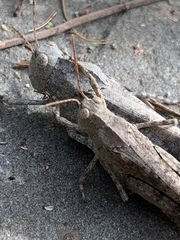 Carolina GrasshopperDissosteira carolinaDamages trees, gardens or crops
 Common Field GrasshopperChorthippus brunneus
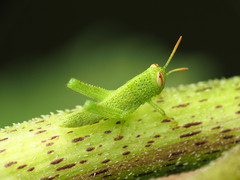 Egyptian Bird GrasshopperAnacridium aegyptium
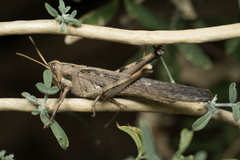 Gray Bird GrasshopperSchistocerca nitensDamages trees, gardens or crops
Sources
- Wikipedia: https://en.wikipedia.org/wiki/Oedipoda_caerulescens
Look it up elsewhere: GBIF · iNaturalist · BugGuide · Wikipedia
Text written 2026-10-23 from the sources above and checked sentence by sentence against them. Data fetched 2026-10-22.