 Bug FAQ
Bloody-nosed Beetle
Timarcha tenebricosa · Order: Coleoptera · Family: Chrysomelidae
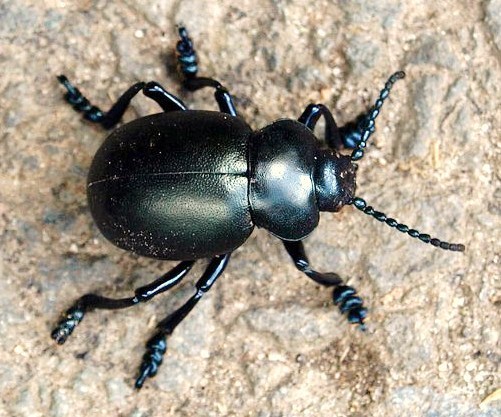
The bloody-nosed beetle is a 15 to 20 mm long beetle that is blue-black in colour and has a more constricted base of the pronotum than its close relative T. goettingensis. It is native to Europe, is active mainly at night, and the larvae feed exclusively on bedstraw while adults wander slowly on ground vegetation. Eggs are laid on bedstraw in spring and the pupae spend the winter before emerging as adults.
Source: Wikipedia
How to recognize it
The beetle is blue-black and its pronotum is broader and more narrowed at the base than that of the similar T. goettingensis.
Source: Wikipedia
Size
It measures about 15 to 20 mm in length.
Source: Wikipedia
Where it lives
It is mainly active at night.
Source: Wikipedia
What it eats
Larvae feed only on bedstraw plants. Adults move slowly on the ground among grass and herbaceous plants.
Source: Wikipedia
Life cycle
Eggs are laid in spring on bedstraw. The pupal stage overwinters.
Source: Wikipedia
When you see it
It is primarily active during the night.
Source: Wikipedia
Where it comes from
It is native to Europe.
Source: Wikipedia
Lookalikes
It looks similar to the lesser bloody-nosed beetle, T. goettingensis.
Source: Wikipedia
More photos


Questions people ask
What do the larvae of the bloody-nosed beetle eat?
The larvae feed exclusively on bedstraw plants.
Source: Wikipedia
How can I tell this beetle apart from T. goettingensis?
It is larger, blue-black, and has a more constricted base of the pronotum than T. goettingensis.
Source: Wikipedia
Same family (Chrysomelidae)
 Spotted Cucumber BeetleDiabrotica undecimpunctataDamages trees, gardens or crops
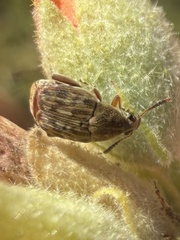 Bean WeevilAcanthoscelides obtectusDamages trees, gardens or crops
 Cowpea WeevilCallosobruchus maculatusDamages trees, gardens or crops
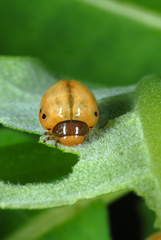 Swamp Milkweed Leaf BeetleLabidomera clivicollisDamages trees, gardens or crops
 Alder Leaf BeetleAgelastica alniDamages trees, gardens or crops
 Dogbane Leaf BeetleChrysochus auratus
Sources
- Wikipedia: https://en.wikipedia.org/wiki/Bloody-nosed_beetle
Look it up elsewhere: GBIF · iNaturalist · BugGuide · Wikipedia
Text written 2026-10-22 from the sources above and checked sentence by sentence against them. Data fetched 2026-10-22.