 Bug FAQ
Black Yellow Owlfly
Libelloides longicornis · Order: Neuroptera · Family: Ascalaphidae

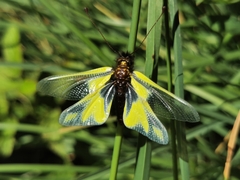
These owlflies are 25 to 30 mm long with a wingspan of 38 to 58 mm. The body is black, hairy and has yellow markings, while the wings are partly transparent with a lemon-yellow rib network. They live in sunny high-elevation meadows of southwestern Europe and are seen as adults from June to August.
Source: Wikipedia
How to recognize it
The body is black, quite hairy and shows some yellow markings. The wings lack scales, are partly transparent and display a network of translucent lemon-yellow ribs.
Source: Wikipedia
Size
Adults reach 25 to 30 mm in length and have a wingspan of 38 to 58 mm.
Source: Wikipedia
Where it lives
They are mainly found in sunny meadows at relatively high elevations.
Source: Wikipedia
Life cycle
Females lay white eggs in closely spaced double rows on the stems of herbaceous plants.
Source: Wikipedia
Where it comes from
The species occurs in southwestern Europe, including France, Germany, Italy, Portugal, Spain and Switzerland.
Source: Wikipedia
Lookalikes
It resembles Libelloides coccajus, but its hind-wing basal black area does not reach the anal angle.
Source: Wikipedia
More photos


Questions people ask
When are adult Libelloides longicornis active?
Adults are seen from June through August.
Source: Wikipedia
What do the larvae look like?
The larvae resemble antlion larvae and do not dig cavities in the ground.
Source: Wikipedia
Where does Libelloides longicornis live?
It is found in southwestern Europe, including France, Germany, Italy, Portugal, Spain and Switzerland.
Source: Wikipedia
Same family (Ascalaphidae)



Sources
- Wikipedia: https://en.wikipedia.org/wiki/Libelloides_longicornis
Look it up elsewhere: GBIF · iNaturalist · BugGuide · Wikipedia
Text written 2026-10-23 from the sources above and checked sentence by sentence against them. Data fetched 2026-10-23.