 Bug FAQ
Owly Sulphur
Libelloides coccajus · Order: Neuroptera · Family: Ascalaphidae
Also called: Owlfly Sulphur, European Owlfly, Owly Sulphu, Sulphur Owlfly
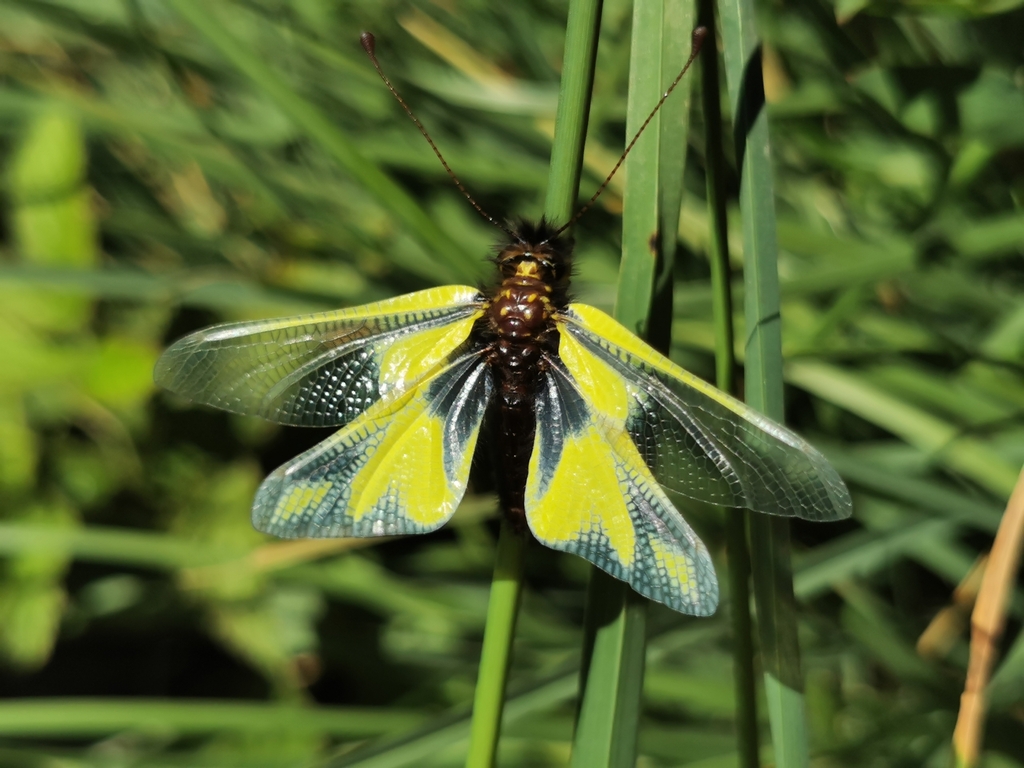
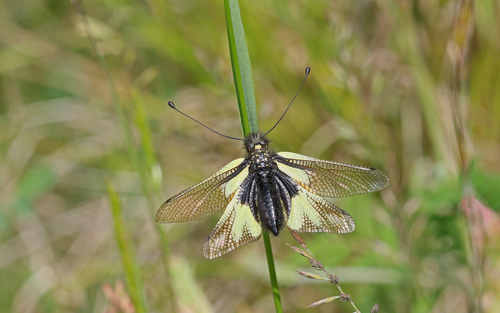
The owly sulphur is a black, hairy insect about 25 mm long with a 45 to 55 mm wingspan; its wings are partly transparent with bright yellow near the base and dark brown on the outer side, plus a black patch near the rear edge. Adults are active from April to July, live about two years, and hunt other flying insects during the day, while the larvae wait on the soil surface to catch prey.
Source: Wikipedia
How to recognize it
The body is black and hairy, with large bulging eyes, long clubbed antennae, and black wing veins; the wings lack scales and show yellow and dark brown areas plus a black rear-edge patch.
Source: Wikipedia
Size
Adults reach 25 mm in length and have a wingspan of 45 to 55 mm (about 1.8 to 2.2 in).
Source: Wikipedia
Where it lives
They prefer tall grass and sunny rocky slopes up to 1,500 m, and have been recorded as high as 1,800 m in the Susa Valley on the French-Italian border.
Source: Wikipedia
What it eats
Adults are daytime predators of other flying insects, and larvae also hunt prey while lying on the soil surface.
Source: Wikipedia
Life cycle
Females lay eggs in clusters on herbaceous plant stems, and the insects live for about two years.
Source: Wikipedia
When you see it
Adults can be seen from April through July.
Source: Wikipedia
Where it comes from
This species occurs in France, the Czech Republic, Germany, Italy, Spain and Switzerland.
Source: Wikipedia
Lookalikes
It resembles the similar species Libelloides lacteus.
Source: Wikipedia
More photos
Questions people ask
What do owly sulphur larvae eat?
The larvae wait on the soil surface and capture other small insects as prey.
Source: Wikipedia
Where does this insect live?
It inhabits tall grass and sunny rocky slopes up to about 1,500 m, with records up to 1,800 m in the Susa Valley.
Source: Wikipedia
How can I tell owly sulphur apart from similar bugs?
Look for a black, hairy body, large bulging eyes, long clubbed antennae, and wings that are partly transparent with yellow near the base and dark brown on the outer side, plus a black patch near the rear edge.
Source: Wikipedia
Same family (Ascalaphidae)

Sources
- Wikipedia: https://en.wikipedia.org/wiki/Libelloides_coccajus
Look it up elsewhere: GBIF · iNaturalist · BugGuide · Wikipedia
Text written 2026-10-22 from the sources above and checked sentence by sentence against them. Data fetched 2026-10-22.