 Bug FAQ
Black Prince
Psaltoda plaga · Order: Hemiptera · Family: Cicadidae
Also called: Black Prince cicada, Silver Knight

The Black Prince cicada is a large insect with forewings about 37-47 mm long, males slightly larger than females. Adults emerge in summer, live for about four weeks, and spend seven years underground as nymphs feeding on plant roots.
Source: Wikipedia
How to recognize it
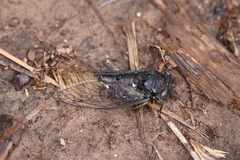
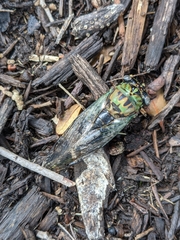
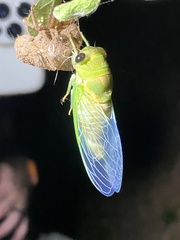
Its forewing shows a dark zigzag near the tip, while the hindwing lacks a border darkening. Male colour varies with age and location.
Source: Wikipedia
Size
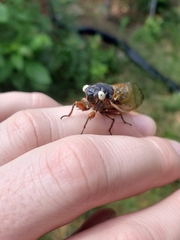
Forewing length is 38-47 mm in males and 37-45 mm in females.
Source: Wikipedia
Where it lives
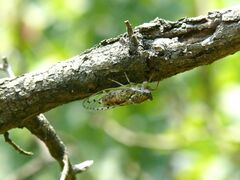
Adults are found in forested areas near water during summer. They perch on branches rather than tree trunks.
Source: Wikipedia
What it eats
It is preyed upon by the cicada-killer wasp, which paralyzes it for its larvae.
Source: Wikipedia
Life cycle
Nymphs live underground for seven years, drinking root sap before emerging as adults. Adults live about four weeks, during which they fly, mate and lay eggs.
Source: Wikipedia
When you see it
Adults appear in summer, especially from December to March in western Sydney.
Source: Wikipedia
Where it comes from
It is native to eastern Australia, from central Queensland to southern New South Wales.
Source: Wikipedia
Lookalikes
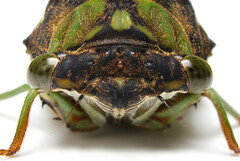
Individuals with green and black markings can be confused with the green baron cicada of North Queensland.
Source: Wikipedia
More photos


Questions people ask
How long do they stay underground?
The nymph stage lasts about seven years beneath the soil.
Source: Wikipedia
Same family (Cicadidae)


Sources
- Wikipedia: https://en.wikipedia.org/wiki/Psaltoda_plaga
Look it up elsewhere: GBIF · iNaturalist · BugGuide · Wikipedia
Text written 2026-10-23 from the sources above and checked sentence by sentence against them. Data fetched 2026-10-22.