 Bug FAQ
Black-headed Jumping Spider
Trite planiceps · Order: Araneae · Family: Salticidae
Source: Wikipedia
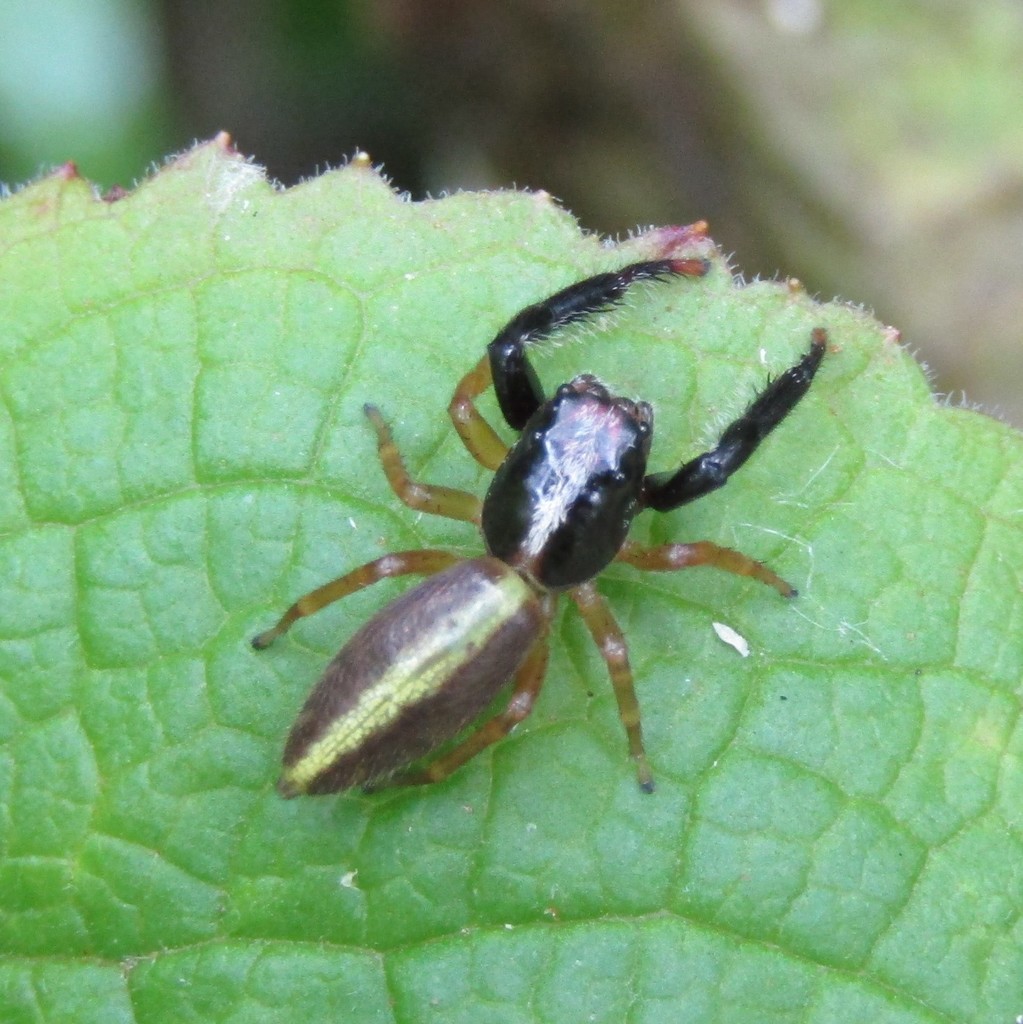
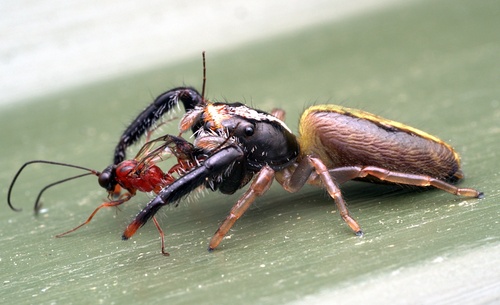
The black-headed jumping spider has a jet-black front body and first pair of legs, with a golden-brown abdomen that may show a yellow stripe or a greenish shine. It lives on native plants such as flax and cabbage trees, often appears around homes, and is found only in New Zealand.
Source: Wikipedia
How to recognize it
The cephalothorax and the first pair of legs are jet black.
Source: Wikipedia
Size
Adults range from about 6 mm to 13.5 mm in body length.
Source: Wikipedia
Does it bite or sting?
People rarely get bitten because the spider is docile and often handled without incident. Bites only occur when the spider feels threatened and acts defensively as a last resort.
Source: Wikipedia
Where it lives
It is commonly found on flax (Phormium) and cabbage trees (Cordyline). It also shows up around houses and gardens.
Source: Wikipedia
What it eats
It hunts by sight during the day and can also capture prey in darkness using vibrations.
Source: Wikipedia
Life cycle
Juveniles and subadults spin flat, tubular silk cocoons with doors at both ends inside rolled leaves. Adult females build a silk platform about half again as long and two to three times as wide as themselves, then lay up to seven egg batches of 8-40 eggs each.
Source: Wikipedia
When you see it
It is mainly active during daylight hours.
Source: Wikipedia
Where it comes from
The species is endemic to New Zealand.
Source: Wikipedia
More photos
Questions people ask
Do they bite people?
Bites are very rare and only happen when the spider is defending itself.
Source: Wikipedia
Where might I find this spider?
Look on flax, cabbage trees, or around the exterior of homes in New Zealand.
Source: Wikipedia
What does it look like?
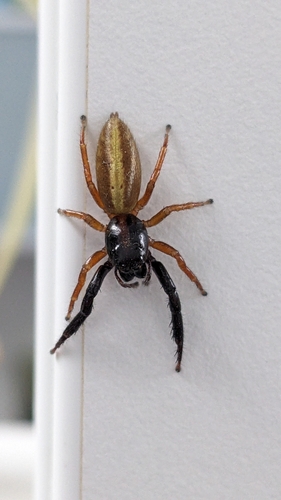
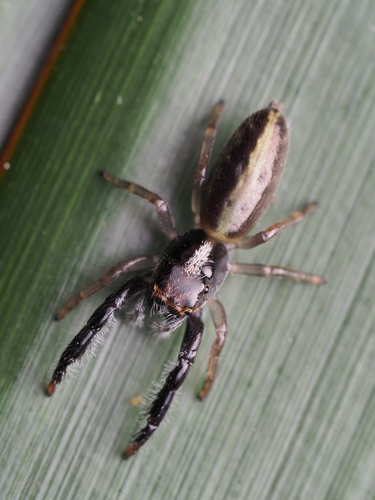
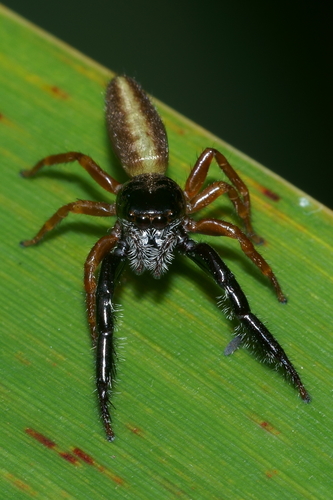
It has a jet-black front body and first pair of legs, with a golden-brown abdomen that may show a yellow stripe or a greenish sheen.
Source: Wikipedia
Same family (Salticidae)



Sources
- Wikipedia: https://en.wikipedia.org/wiki/Trite_planiceps
Look it up elsewhere: GBIF · iNaturalist · BugGuide · ITIS · Wikipedia
Text written 2026-10-23 from the sources above and checked sentence by sentence against them. Data fetched 2026-10-22.