 Bug FAQ
Bird Grasshopper
Schistocerca pallens · Order: Orthoptera · Family: Acrididae
Source: Wikipedia
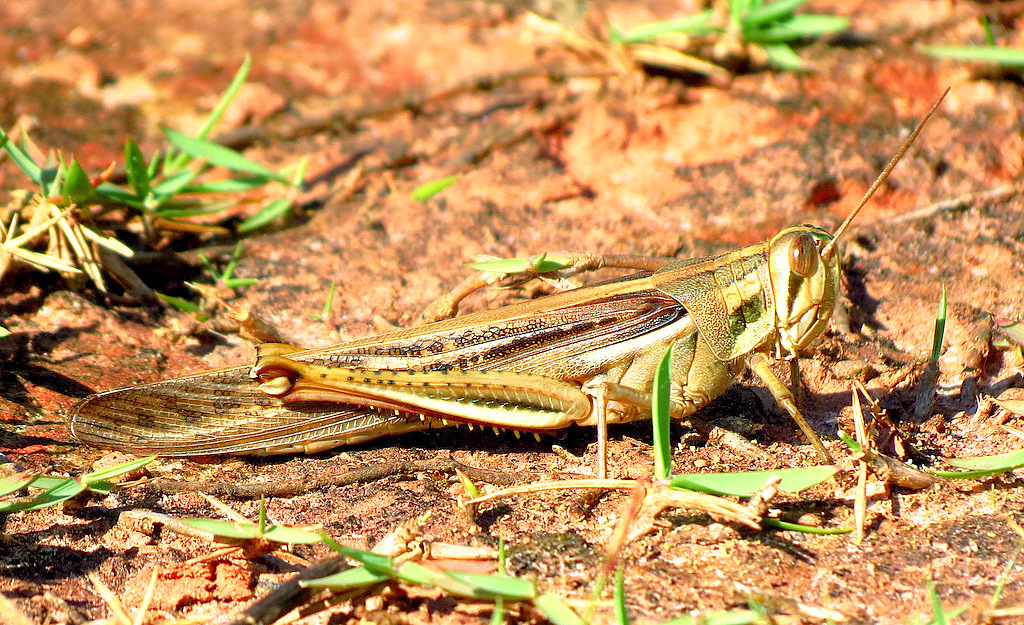
It is a large grasshopper often called a bird grasshopper. Although it never forms swarms, high numbers can still damage fields and gardens.
Source: Wikipedia
Size
Schistocerca pallens is a large grasshopper.
Source: Wikipedia
Is it a pest in the house?
When present in high densities it can cause economic damage to crops and gardens.
Source: Wikipedia
What it eats
It feeds on many cultivated plants, including sugar cane, almond, banana, beans, breadfruit, coconut, cotton, maize, rice, sorghum, sweet potato, tomatoes and others.
Source: Wikipedia
Lookalikes
It looks similar to its close relative Schistocerca cancellata.
Source: Wikipedia
Where it is found in the US
Recorded in 1 of 51 states and DC. Most records: Florida.
Darker = more records. Counts are museum and citizen-science records, not population size.
Source: GBIF
Status: native in North America. Source: iNaturalist
Questions people ask
What crops does Schistocerca pallens damage?
It feeds on sugar cane, almonds, bananas, beans, breadfruit, coconut palms, cotton, maize, rice, sorghum, sweet potatoes, tomatoes and many other crops.
Source: Wikipedia
Does Schistocerca pallens swarm like other locusts?
No, it never shows swarming behavior or phase polymorphism, even when crowded.
Source: Wikipedia
Same family (Acrididae)
 Differential GrasshopperMelanoplus differentialisDamages trees, gardens or crops
 Two-striped GrasshopperMelanoplus bivittatusDamages trees, gardens or crops
 Carolina GrasshopperDissosteira carolinaDamages trees, gardens or crops
 Common Field GrasshopperChorthippus brunneus
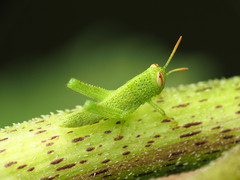 Egyptian Bird GrasshopperAnacridium aegyptium
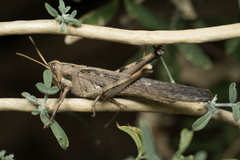 Gray Bird GrasshopperSchistocerca nitensDamages trees, gardens or crops
Sources
- Wikipedia: https://en.wikipedia.org/wiki/Schistocerca_pallens
Look it up elsewhere: GBIF · iNaturalist · BugGuide · Wikipedia
Text written 2026-10-23 from the sources above and checked sentence by sentence against them. Data fetched 2026-10-23.