 Bug FAQ
Beautiful Cosmopterix Moth
Cosmopterix pulchrimella · Order: Lepidoptera · Family: Cosmopterigidae
Also called: Beautiful Cosmo, Chambers' Cosmopterix
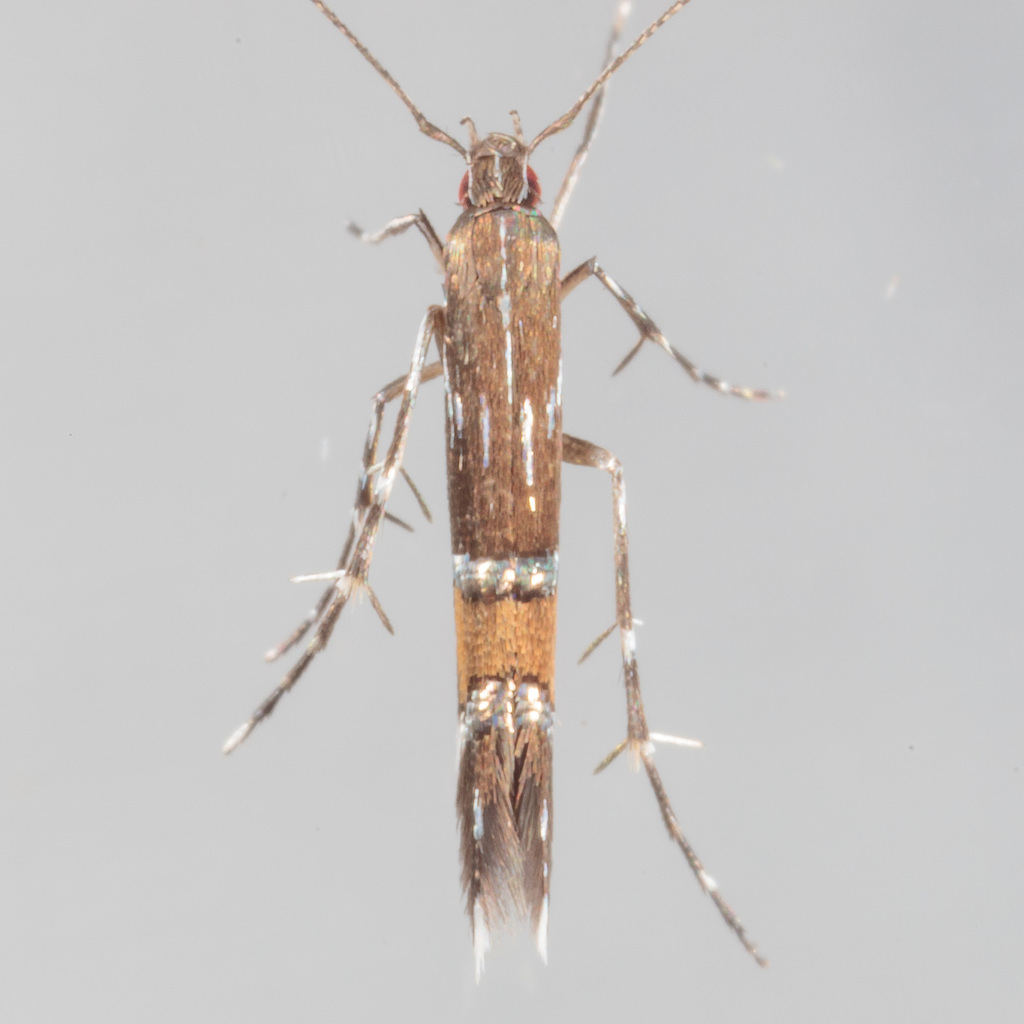
The beautiful Cosmopterix moth has forewings 3 to 4 mm long and a distinctive pattern of dark brown with silver streaks and orange fascia. It occurs across much of North America, from Canada and the northern United States down to Florida, Arizona and New Mexico, and also throughout the Mediterranean region of the Palearctic. Larvae mine the leaves of several Parietaria species and Pilea pumila, while adults can be on wing year-round in the southern part of its range.
Source: Wikipedia
How to recognize it
The forewing is dark brown with three short silver streaks near the base, a bright orange transverse band beyond the middle, and metallic golden-tinged fascia edged with black.
Source: Wikipedia
Size
Forewing length ranges from 3.0 to 4.0 mm.
Source: Wikipedia
Where it lives
It is known from the United States (Massachusetts, Michigan, southern Wyoming, Florida, Arizona, New Mexico) and Canada. It also occurs in the Mediterranean Basin of the Palearctic, from Portugal to the western Transcaucasus and north to Switzerland and Hungary.
Source: Wikipedia
What it eats
Larvae feed on the leaves of Parietaria judaica, P. officinalis, P. pensylvanica and Pilea pumila, mining the leaf tissue.
Source: Wikipedia
Life cycle
The species is bivoltine, producing two generations per year.
Source: Wikipedia
When you see it
Adults can be on wing throughout the year in southern parts of its range.
Source: Wikipedia
Where it comes from
Its native range includes the United States and Canada. It is also native to parts of the Palearctic realm around the Mediterranean.
Source: Wikipedia
Where it is found in the US
Recorded in 30 of 51 states and DC. Most records: Texas, Mississippi, Louisiana, Illinois, Indiana, Oklahoma, Georgia, North Carolina.
Darker = more records. Counts are museum and citizen-science records, not population size.
Source: GBIF
Status: native in North America; native in Canada; native in United States. Source: iNaturalist
Months it is reported in the US
Source: GBIF
More photos


Questions people ask
What plants do the larvae feed on?
The larvae mine the leaves of Parietaria species and Pilea pumila.
Source: Wikipedia
When are adult moths active?
Adults are on wing year-round in the southern part of the range and have two generations per year.
Source: Wikipedia
Same family (Cosmopterigidae)


Sources
- Wikipedia: https://en.wikipedia.org/wiki/Cosmopterix_pulchrimella
Look it up elsewhere: GBIF · iNaturalist · BugGuide · ITIS · Wikipedia
Text written 2026-10-27 from the sources above and checked sentence by sentence against them. Data fetched 2026-10-27.