 Bug FAQ
Banded house mosquito
Culiseta annulata · Order: Diptera · Family: Culicidae
Source: Wikipedia


The banded house mosquito lives across the Palearctic region. Adult females spend the colder months in caves together with some Culex species. They overwinter as adults and are known to bite humans, deer, sheep, pigs and other animals.
Source: Wikipedia
Does it bite or sting?
In the Czech Republic they commonly bite European fallow deer, red deer, humans, sheep, other deer and pigs.
Source: Wikipedia
Life cycle
Adults survive the winter in their mature stage.
Source: Wikipedia
When you see it
Females are present in caves from autumn through early spring in northern Europe.
Source: Wikipedia
Where it comes from
The species is distributed throughout the Palearctic region.
Source: Wikipedia
More photos


Questions people ask
Do they bite people or pets?
Yes, they bite humans and several mammals such as deer, sheep and pigs.
Source: Wikipedia
Where are banded house mosquitoes found?
They are found throughout the Palearctic region.
Source: Wikipedia
When are they active in northern Europe?
Adult females are active in caves from autumn to early spring.
Source: Wikipedia
Same family (Culicidae)
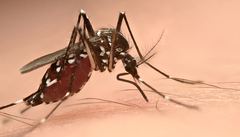 Asian Tiger MosquitoAedes albopictusCan spread germs or disease
 House Mosquito ComplexCulex pipiensCan spread germs or disease
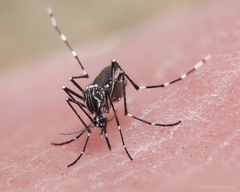 Yellow Fever MosquitoAedes aegyptiCan spread germs or disease
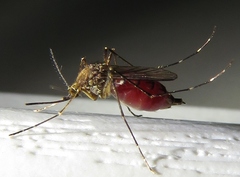 Inland Floodwater MosquitoAedes vexansCan spread germs or disease
 Asian Bush MosquitoAedes japonicusCan bite
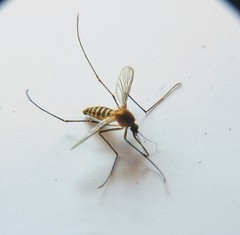 Southern House MosquitoCulex quinquefasciatusCan spread germs or disease
Sources
- Wikipedia: https://en.wikipedia.org/wiki/Culiseta_annulata
Look it up elsewhere: GBIF · iNaturalist · BugGuide · ITIS · Wikipedia
Text written 2026-10-23 from the sources above and checked sentence by sentence against them. Data fetched 2026-10-22.