 Bug FAQ
Banded Harvestman
Leiobunum vittatum · Order: Opiliones · Family: Sclerosomatidae
Also called: Eastern Harvestman

Adult male banded harvestmen are about 5 to 7 mm long and females 7 to 8.5 mm long. They have a dark central marking on the back that runs from the abdomen toward the eyes, plus dark leg segments that help tell them apart. They are native to eastern and central North America and their mating includes separate pre-copulatory and copulatory stages.
Source: Wikipedia
How to recognize it
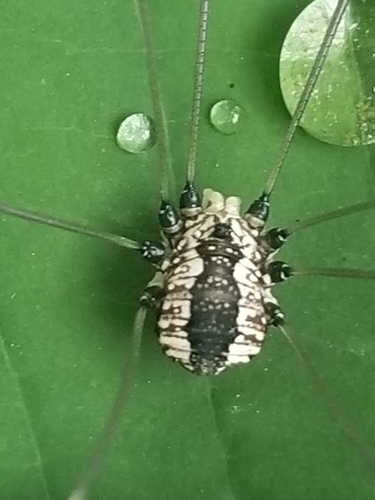
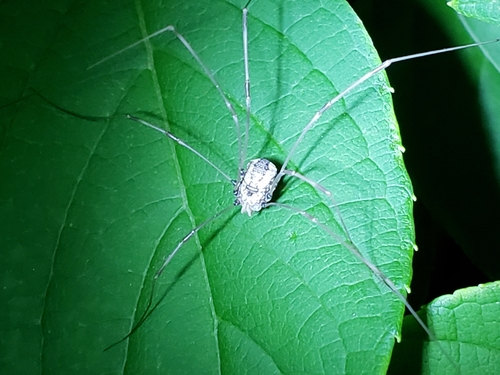
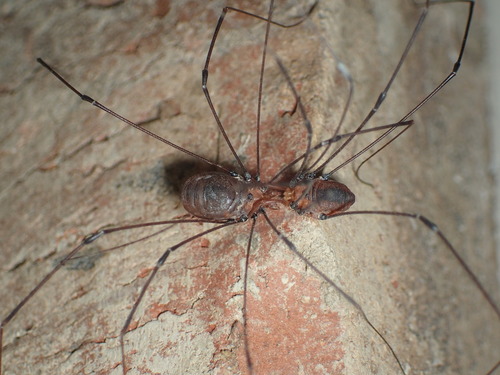
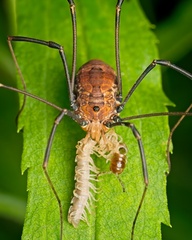
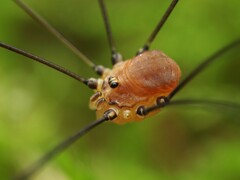
Both sexes usually show a conspicuous dark stripe on the dorsal side that extends from the rear abdomen toward the ocularium. The leg segments called patellae are dark, and the tibiae have dark bands near their tips.
Source: Wikipedia
Size
Males are roughly 5 to 7 mm long, while females range from about 7 to 8.5 mm.
Source: Wikipedia
Where it lives
They are found across eastern and central parts of North America.
Source: Wikipedia
Life cycle
Mating involves distinct pre-copulatory and copulatory phases. Researchers study these stages to understand sexual conflict and mating system evolution.
Source: Wikipedia
Where it comes from
The species is native to North America.
Source: Wikipedia
Lookalikes
Female banded harvestmen can be hard to identify because related species look similar in color and shape.
Source: Wikipedia
Where it is found in the US
Recorded in 42 of 51 states and DC. Most records: Pennsylvania, Maryland, Texas, Virginia, New York, Massachusetts, Wisconsin, Michigan.
Darker = more records. Counts are museum and citizen-science records, not population size.
Source: GBIF
Status: native in North America; native in United States. Source: iNaturalist
Months it is reported in the US
Source: GBIF
More photos
Questions people ask
How can I tell a banded harvestman apart from similar species?
Look for the dark central dorsal stripe and the dark leg markings; females may be harder to distinguish because related species share similar colors.
Source: Wikipedia
Same family (Sclerosomatidae)

Sources
- Wikipedia: https://en.wikipedia.org/wiki/Leiobunum_vittatum
Look it up elsewhere: GBIF · iNaturalist · BugGuide · ITIS · Wikipedia
Text written 2026-10-22 from the sources above and checked sentence by sentence against them. Data fetched 2026-10-22.